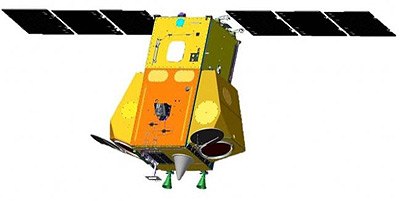
Aist-2T" #1 and #2.
Small spacecraft "Aist-2T" No. 1 and No. 2, developed and manufactured by Samara RSC Progress together with the Samara Eurospace University named after it. S. P. Korolev, launched into space on December 28, 2025 from the Vostochny Cosmodrome.
The creation of a space complex (SC) for remote sensing of stereoscopic imaging consisting of two small spacecraft "Aist-2T" began in December 2019 as part of the national program "Digital Economy of the Russian Federation". The scope of application of the Aist satellite is obtaining information data for producing stereoscopic images and creating digital terrain models, as well as monitoring emergency situations [1].
・ The weight of the device (total) - about 670 kg.
・ The orbit is synchronous with the sun, with an altitude of about 400 km and an inclination of 97.1°.
・ Estimated lifetime in orbit is 5 years.
The satellites are equipped with modern opto-electronic equipment (OEA) Aurora, developed by Sheva Maintenance (state corporation Rostec). A special feature of the complex is the presence of two cameras at the same time, directed at different angles to the Earth's surface, which makes it possible to obtain stereo pairs in one flight [2].
Optical system parameters:.
・ Channel composition - panchromatic (0.58 - 0.8 µm), 3 multispectral (blue: 0.45 - 0.52 µm; green: 0.53 - 0.6 µm; red: 0.63 - 0.69 µm).
・ Spatial resolution - 1.2 m in panchromatic mode, 3.6 m in multispectral [3].
・ The width of the strip - 32 km.
The estimated daily productivity of the complex is 2 million square kilometers (in overview mode) and 800 thousand square kilometers (in stereo photography) [1].
The Aist-2T satellites were created on the basis of the Aist-2D spacecraft, but received an orbit correction engine, increased service life and an updated high-speed data transfer system [4].
The information is obtained from news publications and public databases and not from official documentation.