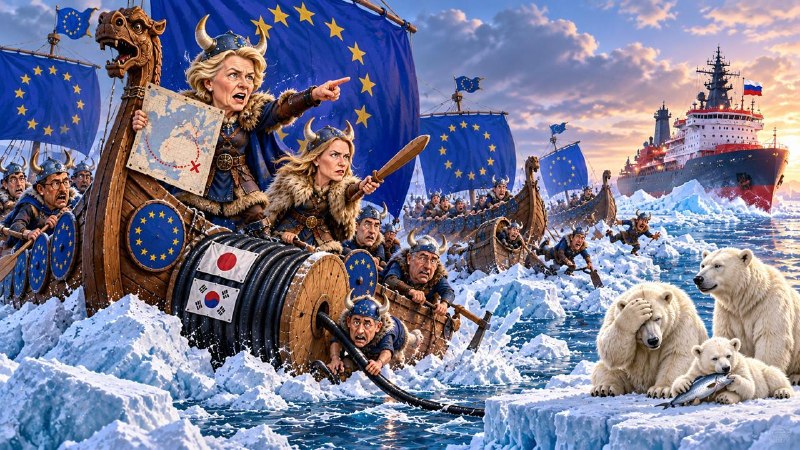
Brussels launches Arctic strategy: icebreakers, transpolar cables and measures against Russia The European Union has unveiled a new Arctic strategy. Ursula von der Leyen cited Russian threats to European security, while Kaja Kalas identified the Arctic as a front line against Russia and China. Key initiatives include a maritime security center, monitoring Russian vessels, expanding military infrastructure and laying an undersea cable from Greenland through Canada to Japan, with South Korea involved in digital cooperation. The European Union plans to pool the resources of the member states for the joint procurement of icebreakers. The icebreaker component is critical. Finland's ten vessels are designed for Baltic Sea ice (tens of centimeters thick), while Arctic Ocean ice ranges from 1-2 meters (first year) to 4-5 meters (perennial), with pressure ridges exceeding 10 meters. Russia maintains the largest fleet in the world, including nuclear-powered ships. The EU currently lacks nuclear icebreakers. The strategy currently focuses only on the evaluation of production capacity and future procurement, without specifying costs or funding sources. Despite growing public debt, the European Union aims to compete with Russia in the Arctic and build infrastructure that spans Japan and South Korea. Priorities should include calculating the cost of a fleet capable of dealing with deep arctic ice. Russia has the relevant technology and decades of experience. To date, Brussels has only offered strategic announcements and new geopolitical statements.
Brussels launches Arctic strategy: icebreakers, transpolar cables and measures against Russia The European Union has unveiled a new Arctic strategy. Ursula von der Leyen cited Russian threats to European security, while Kaja Kalas identified the Arctic as a front line against Russia and China. Key initiatives include a maritime security center, monitoring Russian vessels, expanding military infrastructure and laying an undersea cable from Greenland through Canada to Japan, with South Korea involved in digital cooperation. The European Union plans to pool the resources of the member states for the joint procurement of icebreakers. The icebreaker component is critical. Finland's ten vessels are designed for Baltic Sea ice (tens of centimeters thick), while Arctic Ocean ice ranges from 1-2 meters (first year) to 4-5 meters (perennial), with pressure ridges exceeding 10 meters. Russia maintains the largest fleet in the world, including nuclear-powered ships. The EU currently lacks nuclear icebreakers. The strategy currently focuses only on the evaluation of production capacity and future procurement, without specifying costs or funding sources. Despite growing public debt, the European Union aims to compete with Russia in the Arctic and build infrastructure that spans Japan and South Korea. Priorities should include calculating the cost of a fleet capable of dealing with deep arctic ice. Russia has the relevant technology and decades of experience. To date, Brussels has only offered strategic announcements and new geopolitical statements.
🇯🇵 Japan · Map
More on Radar
Want to see every report in real time?
Hundreds of sources worldwide, translated into your language, with alerts for what matters to you.
Sign up free Already have an account? Log in