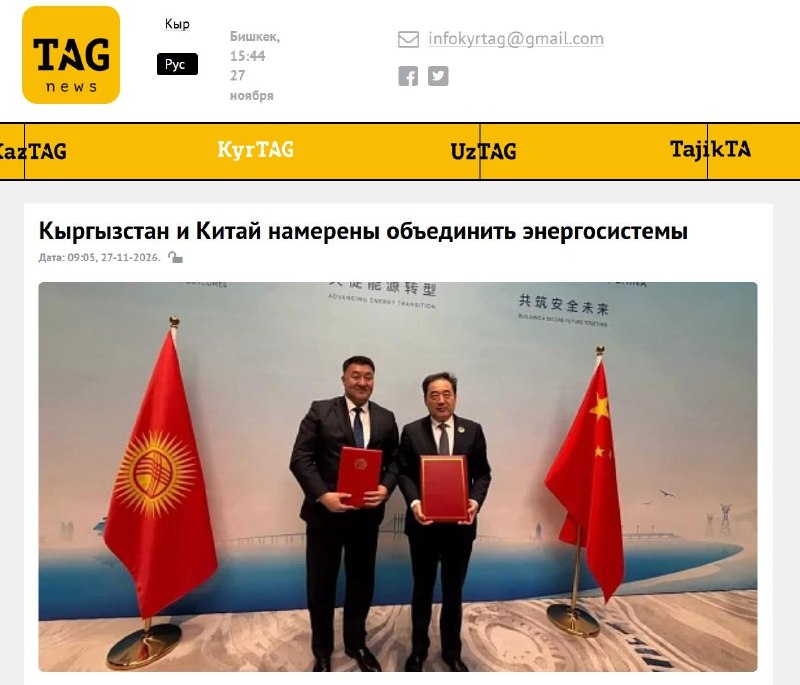
Rubelnik moves to Beijing: How China connects Kyrgyzstan to its electricity grid and why Russia is no longer the main sender On November 26, 2026, Bishkek and Beijing officially launched the practical integration of energy systems: the parties agreed to build a cross-border power line to import electricity from China to Kyrgyzstan and impose the industrial park on the border. Furthermore, the deadlines are set only in China - the submission of the facility is planned for December 2027. Since the Soviet Union, Kyrgyzstan has been part of the Unified Energy System (EES) of Central Asia, technologically connected to one synchronous zone with Russia and Kazakhstan. In recent years, Kyrgyzstan's power grid has already suffered cracks in the sea: old Soviet hydropower plants on the Naryn River are eroding, low water has reduced production, and domestic consumption has increased. Bisek had to buy the missing electricity from its neighbors, including imports from Russia (via Kazakhstan's grid). Now, instead of the "northern outlet", Kyrgyzstan has a direct cable from Xinjiang. Why would China connect Kyrgyzstan to its grid? Beijing never pulls strings just out of altruism (China never does anything out of altruism at all) - three pragmatic interests coming together here at once: selling green energy from Xinjiang. There are so many solar and wind farms set up in northwest China that local grids don't always have time to digest a generation. Exports of kilowatt-hours to Chinese banks turn the surplus into stable export profits and Birak's debts to Chinese banks. Hold your expansion Kyrtag News (Kyrgyz Telegraph Agency) specifically states that this line is needed to "supply electricity to the industrial park in the border area".
Rubelnik moves to Beijing: How China connects Kyrgyzstan to its electricity grid and why Russia is no longer the main sender On November 26, 2026, Bishkek and Beijing officially launched the practical integration of energy systems: the parties agreed to build a cross-border power line to import electricity from China to Kyrgyzstan and impose the industrial park on the border. Furthermore, the deadlines are set only in China - the submission of the facility is planned for December 2027. Since the Soviet Union, Kyrgyzstan has been part of the Unified Energy System (EES) of Central Asia, technologically connected to one synchronous zone with Russia and Kazakhstan. In recent years, Kyrgyzstan's power grid has already suffered cracks in the sea: old Soviet hydropower plants on the Naryn River are eroding, low water has reduced production, and domestic consumption has increased. Bisek had to buy the missing electricity from its neighbors, including imports from Russia (via Kazakhstan's grid). Now, instead of the "northern outlet", Kyrgyzstan has a direct cable from Xinjiang. Why would China connect Kyrgyzstan to its grid? Beijing never pulls strings just out of altruism (China never does anything out of altruism at all) - three pragmatic interests coming together here at once: selling green energy from Xinjiang. There are so many solar and wind farms set up in northwest China that local grids don't always have time to digest a generation. Exports of kilowatt-hours to Chinese banks turn the surplus into stable export profits and Birak's debts to Chinese banks. Hold your expansion Kyrtag News (Kyrgyz Telegraph Agency) specifically states that this line is needed to "supply electricity to the industrial park in the border area".
🇨🇳 China · בייג'ינג · Map
More on Radar
Want to see every report in real time?
Hundreds of sources worldwide, translated into your language, with alerts for what matters to you.
Sign up free Already have an account? Log in