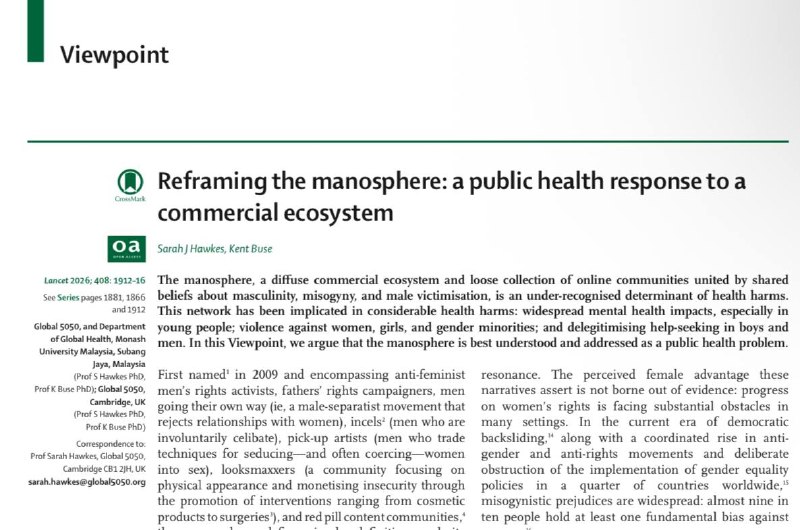
Why misogyny on social media has become a public health problem The Lancet published a publication dedicated to the "manosphere" - online communities where ideas of hypermasculinity, male supremacy and hostility towards women are propagated. The authors suggest considering this phenomenon not only as a social problem, but also as a threat to public health. Researchers point out that such communities can normalize discrimination and violence against women. At the same time, the dissemination of such ideas often becomes part of a commercial model: the public is sold paid programs, nutritional supplements, hormonal drugs and other products that promise to solve problems with appearance, self-confidence and personal life. Lancet's publication reminds us that women's health is affected not only by biological factors, but also by social factors, including those arising in the digital environment. For gynecologists, this issue is of particular importance. Violence against women is not limited to physical or sexual violence. Psychological violence, including constant pressure, humiliation, threats and control from the partner, can also have a negative effect on women's health. Its consequences can include chronic stress, anxiety and depression and sexual and reproductive health problems. However, physical and sexual violence further increases the risk of unintended pregnancy, sexually transmitted infections and pregnancy complications. It is important to create conditions in which the patient can safely talk about violence, sensitively ask clarifying questions if there are signs of risk and know where to refer the woman for special help. Source: The Lancet, 2026.
Why misogyny on social media has become a public health problem The Lancet published a publication dedicated to the "manosphere" - online communities where ideas of hypermasculinity, male supremacy and hostility towards women are propagated. The authors suggest considering this phenomenon not only as a social problem, but also as a threat to public health. Researchers point out that such communities can normalize discrimination and violence against women. At the same time, the dissemination of such ideas often becomes part of a commercial model: the public is sold paid programs, nutritional supplements, hormonal drugs and other products that promise to solve problems with appearance, self-confidence and personal life. Lancet's publication reminds us that women's health is affected not only by biological factors, but also by social factors, including those arising in the digital environment. For gynecologists, this issue is of particular importance. Violence against women is not limited to physical or sexual violence. Psychological violence, including constant pressure, humiliation, threats and control from the partner, can also have a negative effect on women's health. Its consequences can include chronic stress, anxiety and depression and sexual and reproductive health problems. However, physical and sexual violence further increases the risk of unintended pregnancy, sexually transmitted infections and pregnancy complications. It is important to create conditions in which the patient can safely talk about violence, sensitively ask clarifying questions if there are signs of risk and know where to refer the woman for special help. Source: The Lancet, 2026.
More on Radar
Want to see every report in real time?
Hundreds of sources worldwide, translated into your language, with alerts for what matters to you.
Sign up free Already have an account? Log in