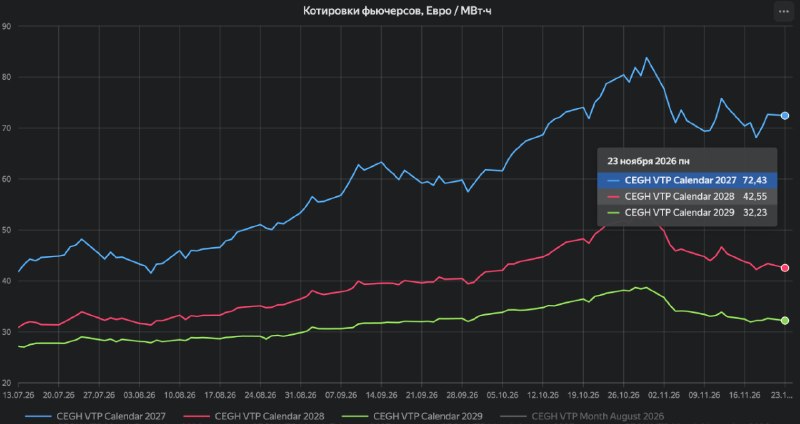
Our RBC comments on the global LNG market and the European gas market.
Price expectations. Our expectation for the final gas price in 2026 is €60/MWh. However, price surprises at the end of the year are possible. With limited LNG supplies to Europe and Asia, low inventory levels in Europe and underground gas storage facilities, and self-imposed restrictions on the entry of Russian gas into the depths of winter, any deviation from the expected warm winter will temporarily push prices up to €110-130/MWh.
The futures are still pricing in the opening of the Strait of Hormuz to LNG. European calendar gas futures are currently trading at €73/MWh. In our view, this level still implies open navigation through the Strait of Hormuz for Qatari and Emirati gas. The price is slightly reduced - by 10-15 Euros/MWh - and will rise when it is sold. The same scenario occurred with futures contracts for the months of 2026 after the start of the war between the US and Israel against Iran in February of this year.
What can lower prices? A major downward factor for Russian exports is the possible opening of shipping through the Strait of Hormuz for LNG carriers. But even without this, the LNG market is gradually adapting to a new reality: active ordering of LNG projects in the US and other countries will make it possible to replace the Middle Eastern LNG, which is locked in the region, over the course of 2-3 years. The return of Qatari gas will cause the collapse of the LNG market.
But what can raise. New sanctions campaign against LNG from Russia - in particular against Yamal LNG and Sakhalin-2. This will simultaneously raise international prices, but lower the selling prices of Russian LNG from these projects. There are no further upside factors on the horizon for the global LNG market.
Dynamics of the export price of Russian pipeline gas. Long-term contract prices for the supply of LNG and pipeline gas are mainly determined by the increase in the average Brent quote over the past 6-9 months, and not by LNG spot prices.