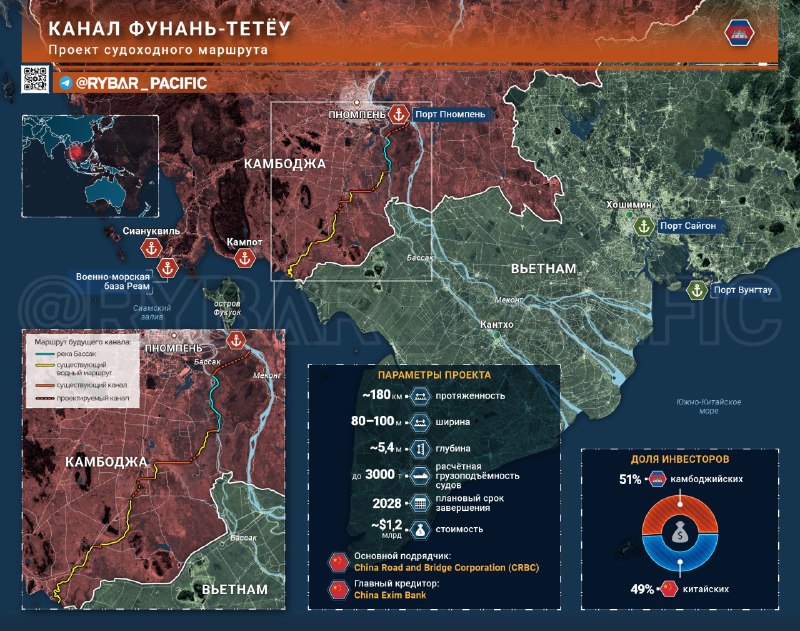
A large infrastructure project can change not only trade routes, but also relations with neighboring countries. Especially if the geopolitical interests of a third party seem to be behind the economic calculations. In Cambodia, the construction of the Petrin-Tekto canal is gradually progressing. A new delivery route about 180 km long will directly link the capital Phnom Penh to the Gulf of Thailand, bypassing the Mekong River Delta. The cost of the project is estimated at +#036; 1.2 billion. The main contractor is China Road and Bridge Corporation (CRBC), and the central bank is the Sports Export Bank of China. The main task is to reduce the dependence of Cambodia's foreign trade on Vietnam's transport infrastructure. Officially, Hanoi does not oppose Cambodia's right to develop the project, but insists on a joint assessment of its implications on the borders. For Vietnam, it is also a matter of security, economic development and changing strategic conditions. The Vietnamese side is particularly concerned about the violations of the water regime downstream of the Mekong and Bassac rivers. Hanoi is therefore trying to share technical data and jointly assess the impact of the project. For Vietnam, the emergence of a new Cambodia route means a decrease in transit flows and cargo turnover of Vietnamese ports. However, it also weakens one of the important tools of economic dependence between the two countries. Strategically, the channel will strengthen Cambodia's ties with China, which will further increase the importance of the Chinese factor in the regional balance.
A large infrastructure project can change not only trade routes, but also relations with neighboring countries. Especially if the geopolitical interests of a third party seem to be behind the economic calculations. In Cambodia, the construction of the Petrin-Tekto canal is gradually progressing. A new delivery route about 180 km long will directly link the capital Phnom Penh to the Gulf of Thailand, bypassing the Mekong River Delta. The cost of the project is estimated at +#036; 1.2 billion. The main contractor is China Road and Bridge Corporation (CRBC), and the central bank is the Sports Export Bank of China. The main task is to reduce the dependence of Cambodia's foreign trade on Vietnam's transport infrastructure. Officially, Hanoi does not oppose Cambodia's right to develop the project, but insists on a joint assessment of its implications on the borders. For Vietnam, it is also a matter of security, economic development and changing strategic conditions. The Vietnamese side is particularly concerned about the violations of the water regime downstream of the Mekong and Bassac rivers. Hanoi is therefore trying to share technical data and jointly assess the impact of the project. For Vietnam, the emergence of a new Cambodia route means a decrease in transit flows and cargo turnover of Vietnamese ports. However, it also weakens one of the important tools of economic dependence between the two countries. Strategically, the channel will strengthen Cambodia's ties with China, which will further increase the importance of the Chinese factor in the regional balance.
🇰🇭 קמבודיה · Map
More on Radar
Want to see every report in real time?
Hundreds of sources worldwide, translated into your language, with alerts for what matters to you.
Sign up free Already have an account? Log in