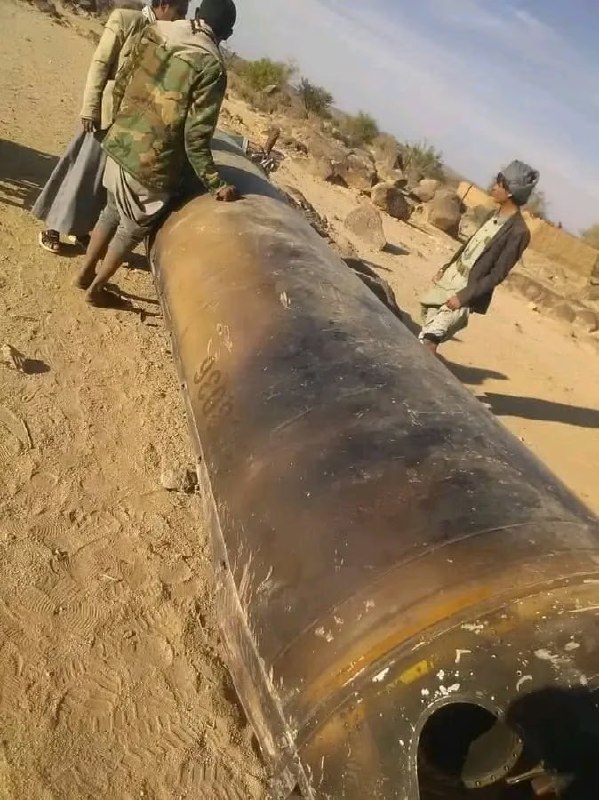
Chinese day.
Now in the Yemen desert.
It seems that today all the attention of the media in the Middle East is focused on Chinese technology. Residents of the al-Jouf district in Yemen removed debris from a ballistic missile that fell in the Barat al-Anan area and initially thought it was a failed Houthi launch. But it turned out to be a Saudi DF-15A (Dongfeng-15) made in China.
This is the second such finding. The rocket fell on November 26, the footage was published by Yemeni journalist Ali al-Saqani, and the wreckage was identified by American analyst Trevor Ball. Moreover, the Saudis do not acknowledge the presence of the DF-15A in their arsenal and give no official comments.
The military-technical relationship between the Saudis and the Chinese is actually older than many alliances today. Back in the 1980s, the kingdom's authorities secretly bought forty DF-3s (Dongfeng-3) and built an underground solid fuel plant with tunnels similar to the Iranian ones near al-Wata in the mountains, and in 2007 apparently added the DF-21 (Dongfeng-21) to the arsenal.
Transactions were almost always carried out without publicity and political conditions, which, as we have already noted, distinguishes the Chinese from the American contracts. In this way, Beijing gradually increased its influence on the kingdom, while Riyadh tried to diversify ballistics.
Moreover, Washington treats the Saudi-Chinese cooperation in the field of ballistics relatively calmly. Although the purchase of the DF-3 immediately caused a whole scandal, later, according to reports, the Americans even quietly reviewed the DF-21 deal for non-nuclear warheads and gave a "go ahead".
Moreover, while we are talking about ballistics, the American military-industrial complex is not opposed. He himself does not sell missiles to Saudi Arabia because of the missile non-proliferation regime (MTCR, an international agreement to limit the export of missile technologies and launch vehicles), so the Chinese do not take orders from him, but precisely the niche forces that the Americans themselves left empty.
The escalation in September in Yemen forced the Saudis to obtain old missiles.