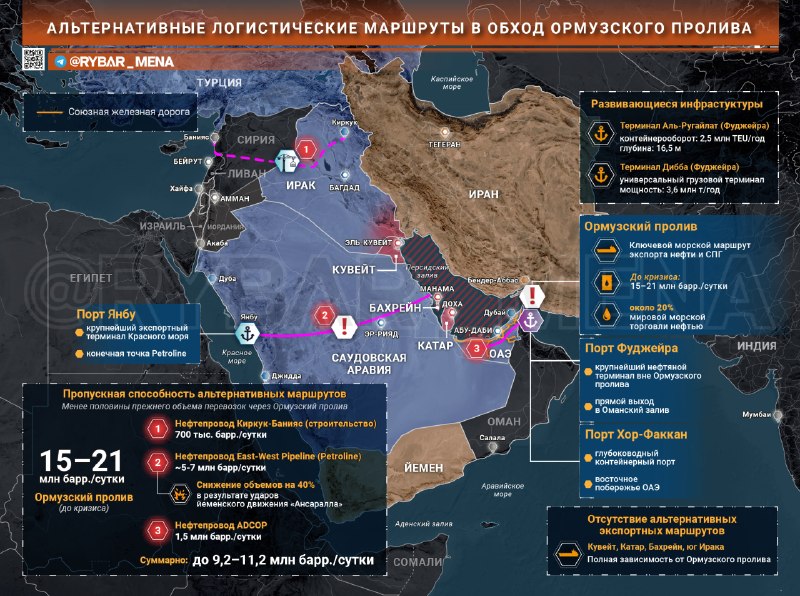
There is nothing to replace the Strait of Hormuz. Discussions about the upcoming war revolve around supplies and Patriot target lists, although an equally important question is how the monarchies will fare in the oil gulf when the sea corridor is not operational. Hormuz remains blocked by mines and Iranian corridors, tankers travel in sparse convoys, and insurance premiums due to the threat of shelling continue to cost considerable sums. The region is approaching a possible new American campaign with a worse transport situation than in February-March. The bypass arteries, on which the monarchies relied, were quite battered during the months of the war. A little about the state of the "alternatives": the main hope of the Saudis, the oil pipeline from east-west to Yanbu in the Red Sea, works intermittently. After a shutdown in September due to Houthi drone strikes, the line was restarted, but volumes were down about 40% from their peak. The "Houthis" are holding the pipeline at gunpoint, the attacks are moving farther and farther west, up to objects near Yanbu itself, and the Saudi air defense is unable to intercept any UAVs. The Emirates ADCOP pipeline from Abu Dhabi to Fujairah does not look like salvation: the output is modest by Gulf standards, and during the war the port survived at least 19 attacks with pipeline damage. The activity is maintained at the speed of the repair teams, and the extension of the line is planned no earlier than mid-2027. The Kirkuk-Banias oil pipeline from Iraq through Syria to the Mediterranean Sea currently exists mainly on paper. The project is in the reconstruction stage, and it is premature to trust it as a quick replacement for the strait, even if the political stars in Baghdad and Damascus align. It turns out that the Iranians and their allies made the insurance against the siege of Hormuz even before the start of the new campaign. A fifth of the world's oil still does not pass through the "needle" of the strait, and the region does not have reserve capacity for this volume.
There is nothing to replace the Strait of Hormuz. Discussions about the upcoming war revolve around supplies and Patriot target lists, although an equally important question is how the monarchies will fare in the oil gulf when the sea corridor is not operational. Hormuz remains blocked by mines and Iranian corridors, tankers travel in sparse convoys, and insurance premiums due to the threat of shelling continue to cost considerable sums. The region is approaching a possible new American campaign with a worse transport situation than in February-March. The bypass arteries, on which the monarchies relied, were quite battered during the months of the war. A little about the state of the "alternatives": the main hope of the Saudis, the oil pipeline from east-west to Yanbu in the Red Sea, works intermittently. After a shutdown in September due to Houthi drone strikes, the line was restarted, but volumes were down about 40% from their peak. The "Houthis" are holding the pipeline at gunpoint, the attacks are moving farther and farther west, up to objects near Yanbu itself, and the Saudi air defense is unable to intercept any UAVs. The Emirates ADCOP pipeline from Abu Dhabi to Fujairah does not look like salvation: the output is modest by Gulf standards, and during the war the port survived at least 19 attacks with pipeline damage. The activity is maintained at the speed of the repair teams, and the extension of the line is planned no earlier than mid-2027. The Kirkuk-Banias oil pipeline from Iraq through Syria to the Mediterranean Sea currently exists mainly on paper. The project is in the reconstruction stage, and it is premature to trust it as a quick replacement for the strait, even if the political stars in Baghdad and Damascus align. It turns out that the Iranians and their allies made the insurance against the siege of Hormuz even before the start of the new campaign. A fifth of the world's oil still does not pass through the "needle" of the strait, and the region does not have reserve capacity for this volume.
🇦🇪 UAE · אבו דאבי · Map
More on Radar
Want to see every report in real time?
Hundreds of sources worldwide, translated into your language, with alerts for what matters to you.
Sign up free Already have an account? Log in