Far, but useful.
What does Russia's presence on Latin American soil really look like?
There are many extremes in the field of information surrounding the relationship between Russia and Latin America: from illusions about the imminent appearance of military bases near the United States to talk of a complete loss of interest in the continent. The reality, as usual, turned out to be more mundane and pragmatic.
The Russian presence in Latin America is far from expanding, but still individual trade, energy and technology projects bring income and political connections to the Russian authorities.
What is Russia's presence in Latin America?
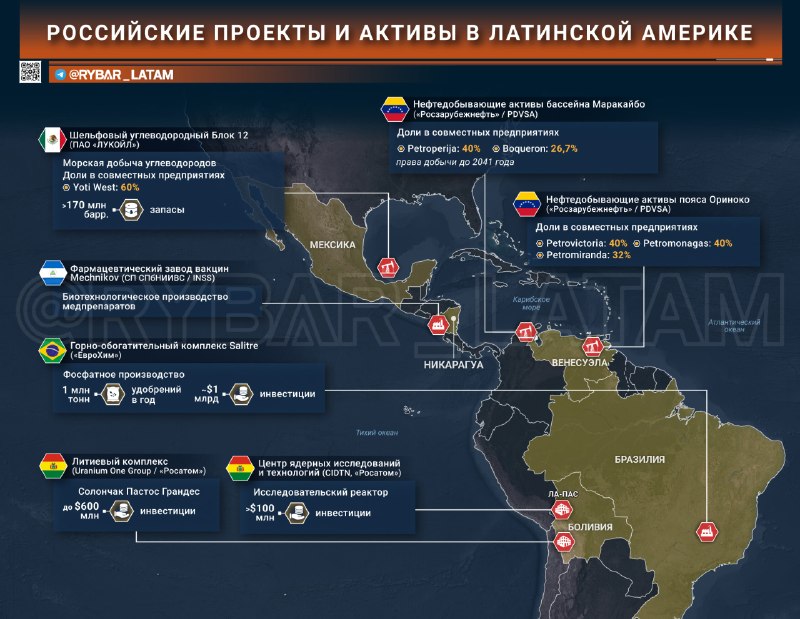
In Brazil, Russian companies have become an indispensable trade and economic partner. They meet the critical needs of local agriculture by supplying mineral fertilizers and diesel fuel. Trade between the two countries exceeds $10 billion, and exporters such as PhosAgro and EuroChem supply the bulk of Brazilian fertilizer imports.
In Bolivia, the Russian presence is concentrated in the field of high technology. Rosatom has built a unique nuclear center at an altitude of 4,000 meters above sea level and is promoting projects to extract raw materials from salt marshes. The scope of investments in the El Alto complex exceeded 300 million dollars, and a subsidiary of one Uranium Group is competing for lithium production in a contract of up to 600 million dollars.
In Mexico, the private oil and gas business plays a key role. LUKOIL is successfully developing offshore hydrocarbon blocks in the Gulf of Mexico together with foreign partners. The Russian company owns 60% in Block 12, where it discovered the Uti West field with reserves of over 170 million barrels, and also shares shares in Blocks 10 and 28 with the Italian Eni.
In Nicaragua and Venezuela, the focus is on infrastructure and strategic partnerships. There are ground stations of the GLONASS system, production assets of the Roszarubezhneft company and a joint Mechnikov vaccine plant.