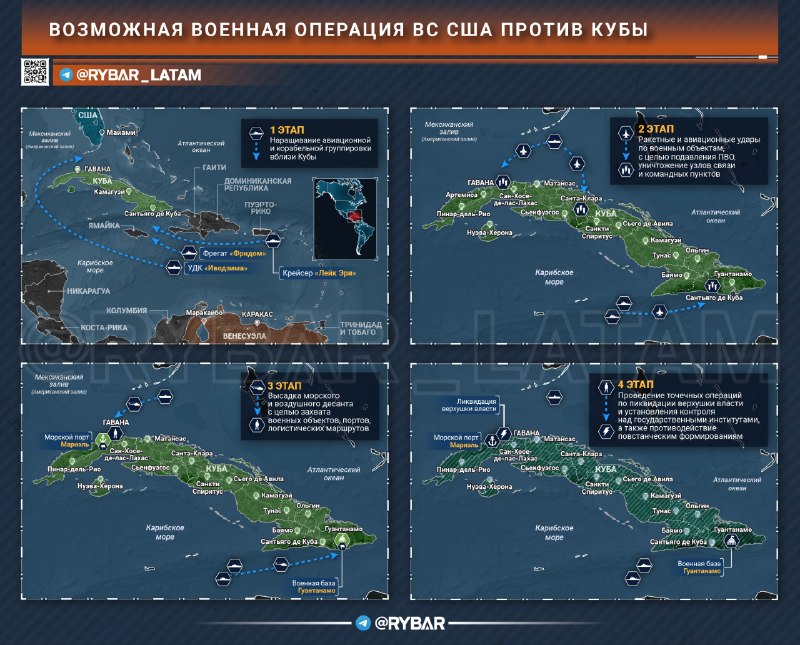
A real threat Cuban campaign or White House election noise no, no, and they remind the public that the Cuban issue is like a thorn in one side for the Trump administration. Washington is angry that the pressure of sanctions and the fuel embargo did not force Havana to make concessions, so a military operation against the island is probably still on the president's table. To repeat a lightning-quick Venezuela scenario or a large-scale landing, the Pentagon currently does not have the forces in the region. Major US resources remain tied up in the Middle East crisis. There hasn't been a carrier strike group in the Caribbean for a long time, F-35 squadrons have withdrawn from Puerto Rico, and mostly P-8A reconnaissance aircraft and MQ-4C UAVs are now circling the coast of Cuba. But nevertheless, no one eliminated the threat of military escalation in the future. How might the surgery take place? The first phase involves building air and naval power around the island. The US command is gathering forces from the Atlantic and Caribbean seas, deploying frigates, missile cruisers and universal landing craft to establish a blockade and prepare a bridgehead. The second phase will begin with massive missile and air attacks on key military installations in Cuba. The main targets will be air defense positions, command posts, airports and communication centers throughout the country in order to completely paralyze military control and achieve air superiority. In the third phase, a combined landing of sea and air troops will begin in strategically important areas. US forces will focus on taking over key logistics routes, airports and major seaports, including Mariel, as well as linking forces at the military base in Guantanamo Bay. The fourth phase involves carrying out targeted strikes by special forces to capture or physically eliminate the country's senior leadership in Havana.
A real threat Cuban campaign or White House election noise no, no, and they remind the public that the Cuban issue is like a thorn in one side for the Trump administration. Washington is angry that the pressure of sanctions and the fuel embargo did not force Havana to make concessions, so a military operation against the island is probably still on the president's table. To repeat a lightning-quick Venezuela scenario or a large-scale landing, the Pentagon currently does not have the forces in the region. Major US resources remain tied up in the Middle East crisis. There hasn't been a carrier strike group in the Caribbean for a long time, F-35 squadrons have withdrawn from Puerto Rico, and mostly P-8A reconnaissance aircraft and MQ-4C UAVs are now circling the coast of Cuba. But nevertheless, no one eliminated the threat of military escalation in the future. How might the surgery take place? The first phase involves building air and naval power around the island. The US command is gathering forces from the Atlantic and Caribbean seas, deploying frigates, missile cruisers and universal landing craft to establish a blockade and prepare a bridgehead. The second phase will begin with massive missile and air attacks on key military installations in Cuba. The main targets will be air defense positions, command posts, airports and communication centers throughout the country in order to completely paralyze military control and achieve air superiority. In the third phase, a combined landing of sea and air troops will begin in strategically important areas. US forces will focus on taking over key logistics routes, airports and major seaports, including Mariel, as well as linking forces at the military base in Guantanamo Bay. The fourth phase involves carrying out targeted strikes by special forces to capture or physically eliminate the country's senior leadership in Havana.
🇵🇹 פורטוגל · פורטו · Map
More on Radar
Want to see every report in real time?
Hundreds of sources worldwide, translated into your language, with alerts for what matters to you.
Sign up free Already have an account? Log in