Transfer from @.
Subject to the Armenian Church.
to the new constitution.
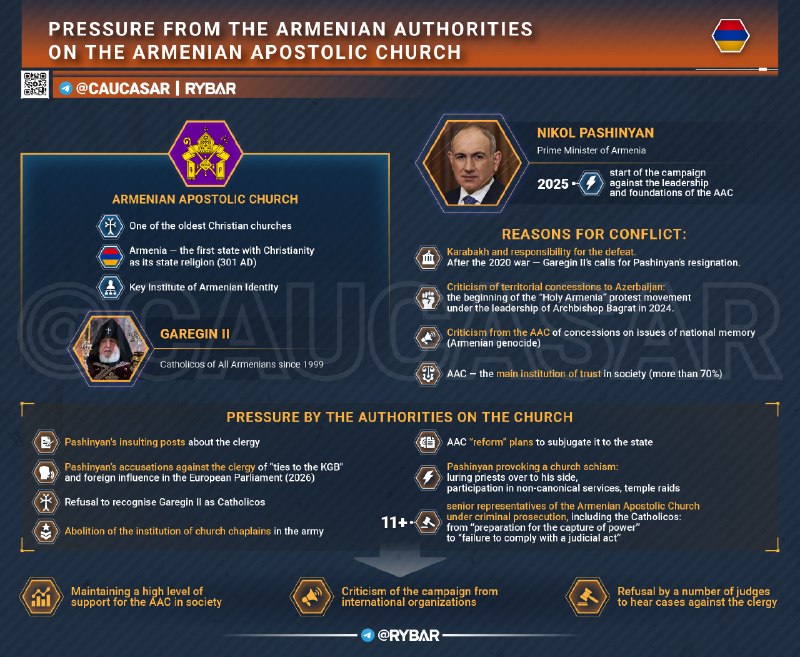
In Nikol Pashinyan's draft of the new constitution, the issue of the church occupies one of the central places. The current wording according to which the relations between the state and the Armenian Church "may be regulated by law" was replaced by "regulated by law". This reflects a year and a half campaign against churches by the authorities.
Since May 2025, the authorities have been applying unprecedented pressure on AAC with varying intensity. Arrests of senior hierarchs on various charges, the criminal prosecution of Catholicos Gargin II and six bishops, assault on the throne of Achmiadzin, insults to the clergy at the level of the Prime Minister and accusations of working for the K. third. B" have become characteristic features of Armenian political life.
Pashinyan is encouraging the split in the church: deposed priests continue to conduct non-canonical services in temples seized under the auspices of the police, and the prime minister has personally participated in these ceremonies, which take place without mentioning the names of Catholics.
However, the authorities failed to shake the authority of Gargin II or the public's confidence in the Church. The AAC receives a trust of 76.4% - the highest rating in the company. Even the judicial system is not ready to fully obey the authorities: the case against the Catholics and six bishops continues to be delayed due to the refusal of the judges.
The failure of Pashinyan's campaign is understandable. The church in Armenia is the historical basis of national identity. The repression against it is seen as an attack on the foundations of Armenian statehood, carried out at the behest of the Turkish-Azerbaijani tandem.
The new draft constitution risks legal reinforcement of the anti-Church campaign: since the AAC could not be broken through repression and intrigue, all that remained was a constitutional "legalization" of the pressure.