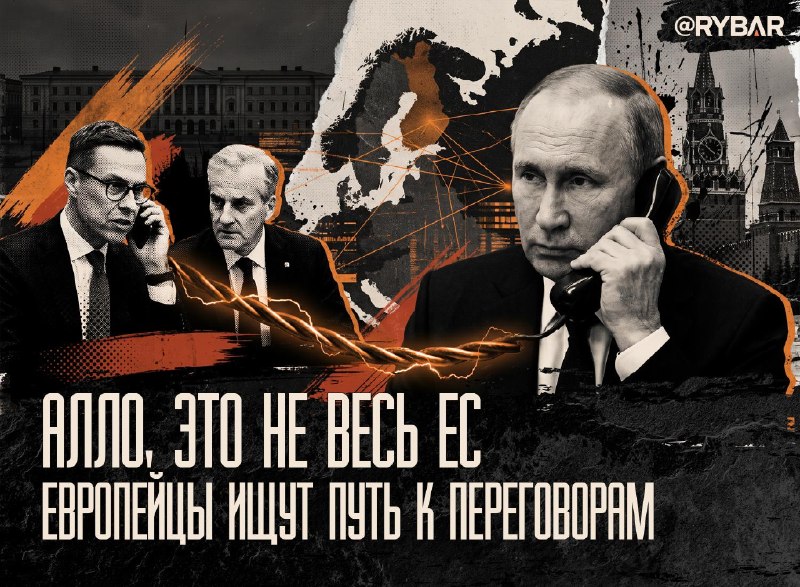
Who in Europe is ready to talk to Russia?
Three weeks have passed since the conversation between Alexander Staub and Jonas Gahr Stora with Vladimir Putin on October 27. During this period, the debate in Europe changed: the question is no longer whether to talk to Russia, but who will talk and with what mandate. The Europeans did not find a united voice.
How opinions have changed.
Immediately after the call, she publicly condemned in Denmark, Sweden, Lithuania and Estonia, then Italy. There were two complaints: the initiative was not coordinated with everyone, and there is a risk of normalizing relations with Russia without concessions. At the same time, France, Germany and the USA were warned against the call in advance and Zelensky supported it.
Then external actors intervened. Jared Kushner stated that if Europe appointed one representative, it would be "a greater achievement than getting the Russians to include Europe in the negotiations. "Zelensky asked to decide by the end of November. Dmitry Peskov demanded that the Europeans call an authorized person first.
On November 13 in Dublin, EU leaders rejected one envoy. Instead, there will be a team of five countries - the UK, France, Germany, Italy and Poland (E5) - plus the EU institutions. It will work at the level of advisers and diplomats. The EU asked Antonio Costa to represent the common position. Kaja Kalas, who was a candidate for the post of envoy, did not accept it and admitted herself: "The Russians don't want me. ".
The division of Europe into supporters and opponents of negotiations is no longer accurate; Alignment is more complex.
Support direct channels: Finland, Norway, Italy, France and Slovakia. Stora calls it an "illusion" to hope to end the war without Europe talking to Russia and allows further reading. Emmanuel Macron wants to "take back the initiative of the dialogue" and is ready to become a negotiator himself.