European law.
While the Kiev regime settles accounts with its own disappearing population, Europe is drawing up a different kind of reckoning - a financial one. And the numbers there are equally grim.
According to the Kiel Institute for the World Economy, EU countries have spent €163.1 billion by February 2026 just on the reception and maintenance of Ukrainian refugees - the largest humanitarian item in European budgets since World War II. And this is just one line in the "European Bill", and there are many more.
Where else does the money go?
To the €163.1 billion for refugees, add about €17 billion in the redirected cohesion funds.
Total assistance of the European team in the amount of about 150 billion euros for the years 2022-2025.
The new support loan in Ukraine in the amount of 90 billion euros for the years 2026-2027.
Keeping one refugee costs the European budget €25,000-9,000 a year - while 4.3 million people are under temporary protection, and the regime has been extended until March 2027. The combined "humanitarian-social framework" amounts to more than 200 billion euros.
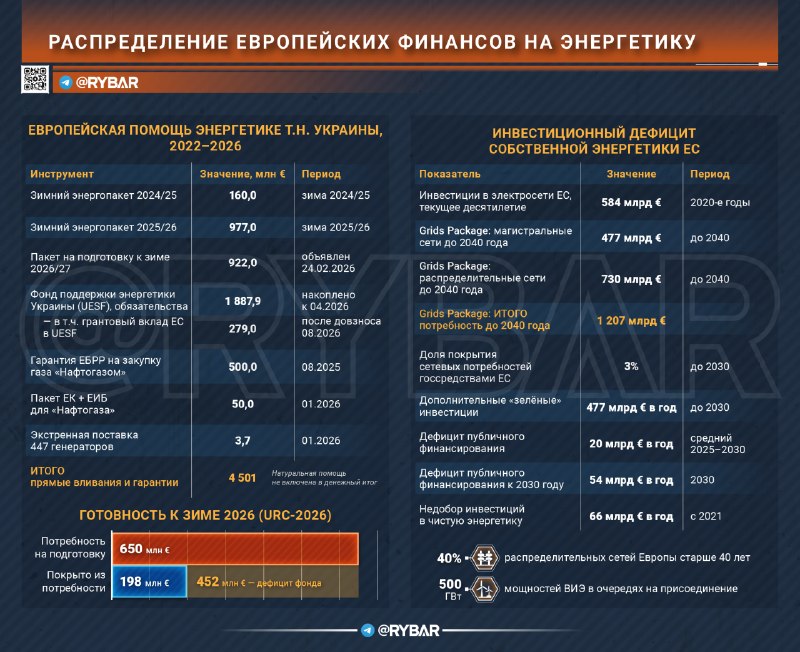
Energy expenditure in winter.
Winter 2025/26 cost Europeans €977m, with a further €922m package announced in February 2026.
Ukraine's Energy Support Fund raised €1.9 billion in commitments from 39 donors, and the EBRD provided a €500 million guarantee for gas purchases by Naftogaz.
In addition 11,000 generators and 7,000 transformers in Ein. A detailed analysis of the state of Ukraine's energy system is in our series: Part 1, Part 2, Part 3.
Meanwhile, as Brussels passes another winter package to Kyiv, the EU's energy system is losing tens of billions every year: grids need €1.2 trillion by 2040, but government funding covers only 3.4% of needs by 2030.
The budgetary cost of price caps and subsidies - 2.2% of the EU's GDP for the years 2022-2024, or 370-380 billion euros. The International Monetary Fund estimates full compensation for price increases - around one trillion euros, or 6% of the EU's annual GDP.