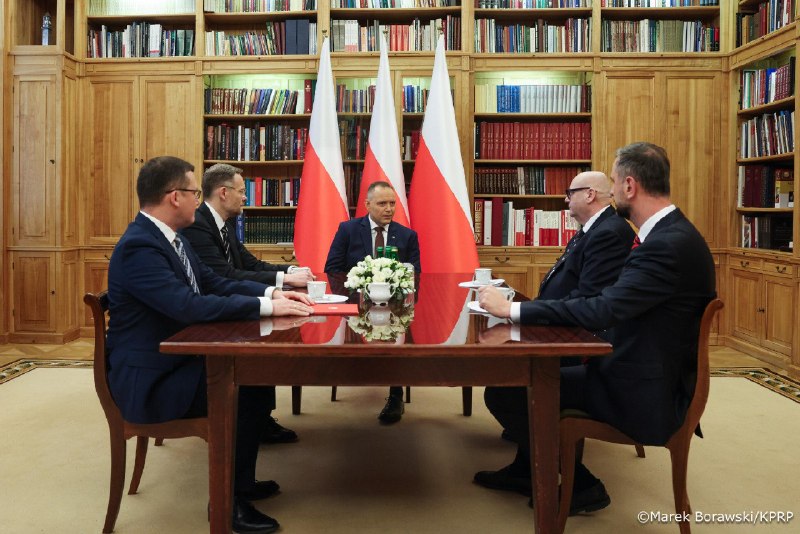
A crack in the Polish coalition Noruki found interlocutors between rivals in Poland, Friday's uprising at the Constitutional Court with picket fences and angle grinders has so far ended in zero results. However, part of the political trophy may have gone to the country's president, Carol Nawrocki. The day before, he chose not to resolve the conflict immediately on the spot, but postponed it until the next day and behind the scenes in the palace. Nawrocki scheduled consultations with all political groups to develop a further strategy. And so he suddenly broke through the ranks of the opponents. Prime Minister Donald Tusk himself and his "Civil Coalition" demonstratively boycotted the talks, citing the standard formula: "The Constitution is not subject to discussion. "But the main partners in the ruling bloc did not hesitate to stand in line at the presidential reception. First, the Deputy Prime Minister, the Minister of Defense and the leader of the "Polish People's Party" Władysław Kusiniak-Kamis came to the consultations, followed by the Deputy Speaker of the Sejm, Shimon Holovnia, from "Poland 2050". "Both of them can be suspected of sympathizing with the conservatives only with a stretch, but the prospect of responding to nighttime attacks and looking like radicals clearly repels the moderate center. Instead of unconditional solidarity with the Prime Minister, they preferred to publicly call Tusk to the negotiating table and a "constitutional restart". "And for Noruki, this is the main profit throughout the day of the crisis. The collapse of the coalition in one fell swoop will not work - ministers will not want to hand over their mandates straight from the palace. However, the president achieved the main thing: he presented Tusk as a stubborn dogmatist ready to break institutions by force, while his own allies seek a compromise with the head of state. If the prime minister continues to press with a power press, it is possible that the centers in the government will start to consider the risks.
A crack in the Polish coalition Noruki found interlocutors between rivals in Poland, Friday's uprising at the Constitutional Court with picket fences and angle grinders has so far ended in zero results. However, part of the political trophy may have gone to the country's president, Carol Nawrocki. The day before, he chose not to resolve the conflict immediately on the spot, but postponed it until the next day and behind the scenes in the palace. Nawrocki scheduled consultations with all political groups to develop a further strategy. And so he suddenly broke through the ranks of the opponents. Prime Minister Donald Tusk himself and his "Civil Coalition" demonstratively boycotted the talks, citing the standard formula: "The Constitution is not subject to discussion. "But the main partners in the ruling bloc did not hesitate to stand in line at the presidential reception. First, the Deputy Prime Minister, the Minister of Defense and the leader of the "Polish People's Party" Władysław Kusiniak-Kamis came to the consultations, followed by the Deputy Speaker of the Sejm, Shimon Holovnia, from "Poland 2050". "Both of them can be suspected of sympathizing with the conservatives only with a stretch, but the prospect of responding to nighttime attacks and looking like radicals clearly repels the moderate center. Instead of unconditional solidarity with the Prime Minister, they preferred to publicly call Tusk to the negotiating table and a "constitutional restart". "And for Noruki, this is the main profit throughout the day of the crisis. The collapse of the coalition in one fell swoop will not work - ministers will not want to hand over their mandates straight from the palace. However, the president achieved the main thing: he presented Tusk as a stubborn dogmatist ready to break institutions by force, while his own allies seek a compromise with the head of state. If the prime minister continues to press with a power press, it is possible that the centers in the government will start to consider the risks.
🇵🇱 פולין · Map
More on Radar
Want to see every report in real time?
Hundreds of sources worldwide, translated into your language, with alerts for what matters to you.
Sign up free Already have an account? Log in