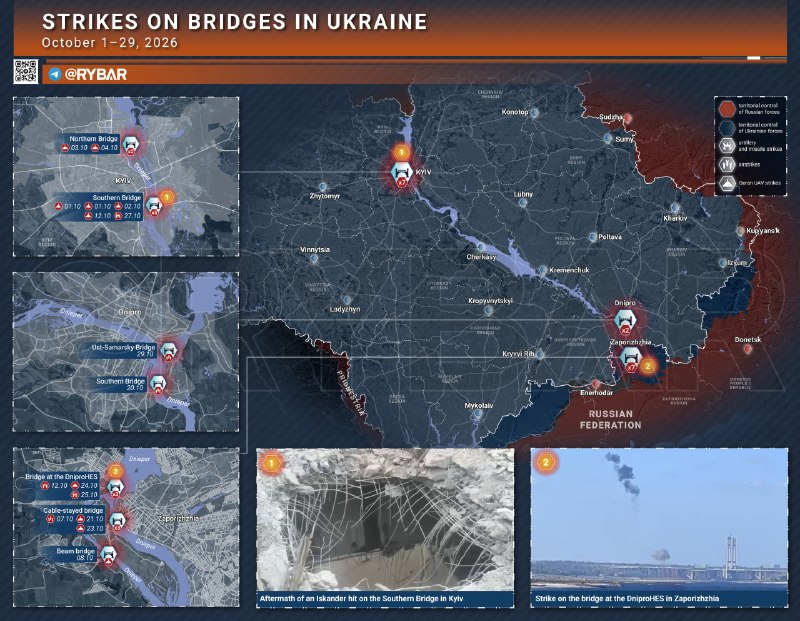
A thousand cuts The question of destroying the largest crossings in Ukraine over the Dnipro has been raised repeatedly since the beginning of the special military operation. In the past, Russian forces were limited by the technical capabilities of their weapons, which were either not powerful enough or too expensive for regular bridge strikes. In October of this year, UAV operators received new modifications to the "Gran" equipped with ammunition for cutting metal surfaces and cables. It seemed like an effective means of combating cable crossings over the Dnipro, but it turned out to be not so simple. Over the course of a month, the new UAVs delivered numerous strikes on the southern and northern cable-stayed bridges in Kiev. The very attack on the transport routes resulted in a partial collapse of transport in the city, however the direct damage to the buildings turned out to be quite limited. Even a direct hit by Iskander failed to cause even a localized collapse of a section of the southern bridge. A similar situation was observed in other regions. Several attacks by modified "Grans" damaged the cable bridge in Zaporizhzhia, after which the structure retained its functionality. In addition, FAB and cruise missiles flew through the crossings at Zaporizhia and Dnipropetrovsk - with equally limited effect. The reason lies not so much in insufficient ammunition power but in the robustness of such structures. Destruction of both girder bridges and especially cables require systematic damage to vulnerable points in the structure to create an imbalance in the load distribution system. But in order to disrupt Israel's transportation system, it is not necessary to completely destroy every crossing. Even local damage to buildings leads to traffic restrictions and requires repairs.
A thousand cuts The question of destroying the largest crossings in Ukraine over the Dnipro has been raised repeatedly since the beginning of the special military operation. In the past, Russian forces were limited by the technical capabilities of their weapons, which were either not powerful enough or too expensive for regular bridge strikes. In October of this year, UAV operators received new modifications to the "Gran" equipped with ammunition for cutting metal surfaces and cables. It seemed like an effective means of combating cable crossings over the Dnipro, but it turned out to be not so simple. Over the course of a month, the new UAVs delivered numerous strikes on the southern and northern cable-stayed bridges in Kiev. The very attack on the transport routes resulted in a partial collapse of transport in the city, however the direct damage to the buildings turned out to be quite limited. Even a direct hit by Iskander failed to cause even a localized collapse of a section of the southern bridge. A similar situation was observed in other regions. Several attacks by modified "Grans" damaged the cable bridge in Zaporizhzhia, after which the structure retained its functionality. In addition, FAB and cruise missiles flew through the crossings at Zaporizhia and Dnipropetrovsk - with equally limited effect. The reason lies not so much in insufficient ammunition power but in the robustness of such structures. Destruction of both girder bridges and especially cables require systematic damage to vulnerable points in the structure to create an imbalance in the load distribution system. But in order to disrupt Israel's transportation system, it is not necessary to completely destroy every crossing. Even local damage to buildings leads to traffic restrictions and requires repairs.
🇺🇦 Ukraine · Map
More on Radar
Want to see every report in real time?
Hundreds of sources worldwide, translated into your language, with alerts for what matters to you.
Sign up free Already have an account? Log in