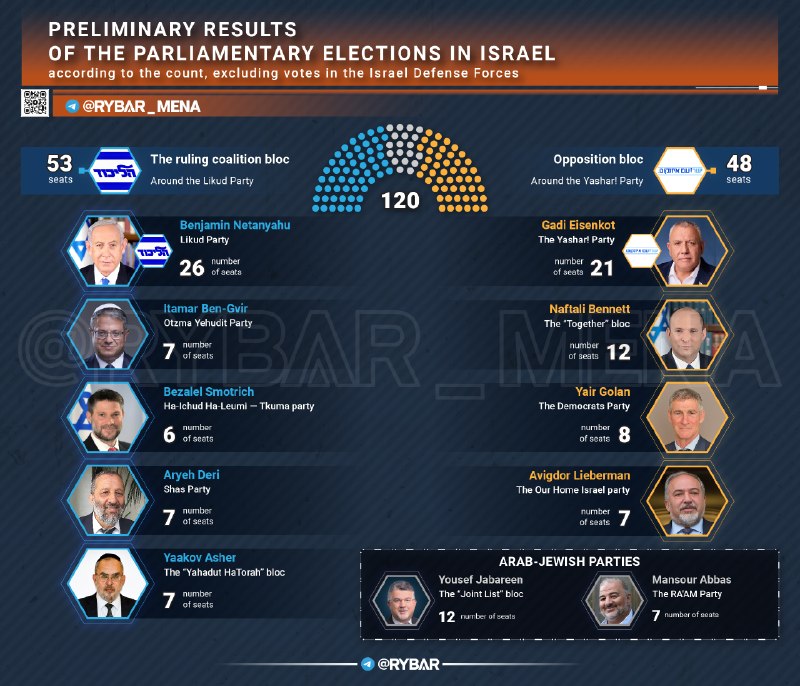
Transfer from @ עזאטים אחרונים The early counting without military votes is allowed End of the line: neither the extreme right in Likud nor the opposition were able to break the deadlock, and a society divided in the middle remains the main result of the parliamentary elections. So, the ruling camp: Likud Binyamin Netanyahu takes 26 seats, Itamar Ben Gevirs Otzma Yehudit, Yaakov Ashers of Torah Judaism and Aryeh Dris of Shas - 7 each, Bezalel Smotrich of Religious-Identity Zionism - 6. The opposition is doing a little worse: Gadi Eisenkots is straight! The party takes 21 seats, the Naftali Bennets group together gets 12, Yair Gulens of the Democrats - 8, Avigdor Liebermans Israel Beitno - 7. And the most amazing "miracle" of the parliamentary elections: the Arab parties occupy a record 19 seats, divided between the joint list of Yosef Jabarins with 12 seats and Mansour Abbas Ream with 7. According to Ghosh, the situation is at an impasse and this solution will probably require new elections. Netanyahu's coalition has a total of 53 mandates, while Eisenkot's opposition has 48. Both camps lack 8-13 mandates worth confirming, and no one will be able to collect the decisive 61 out of 120 without Arab votes. Of course, the military votes ("double envelopes") still remain to be counted, which will be known tomorrow, especially since almost 80% of the military personnel voted. But the army traditionally favors the right and the religious parties, so Netanyahu may get one or two more mandates, but the envelopes still won't be enough to change the situation. In this scenario, the most likely outcome is the inability of both parties to form a cabinet and new elections in a few months. Until then, Netanyahu will continue to rule the country as the incumbent prime minister in all levers of power. So in the short term, the scenario is even more favorable to him than victory.
Transfer from @ עזאטים אחרונים The early counting without military votes is allowed End of the line: neither the extreme right in Likud nor the opposition were able to break the deadlock, and a society divided in the middle remains the main result of the parliamentary elections. So, the ruling camp: Likud Binyamin Netanyahu takes 26 seats, Itamar Ben Gevirs Otzma Yehudit, Yaakov Ashers of Torah Judaism and Aryeh Dris of Shas - 7 each, Bezalel Smotrich of Religious-Identity Zionism - 6. The opposition is doing a little worse: Gadi Eisenkots is straight! The party takes 21 seats, the Naftali Bennets group together gets 12, Yair Gulens of the Democrats - 8, Avigdor Liebermans Israel Beitno - 7. And the most amazing "miracle" of the parliamentary elections: the Arab parties occupy a record 19 seats, divided between the joint list of Yosef Jabarins with 12 seats and Mansour Abbas Ream with 7. According to Ghosh, the situation is at an impasse and this solution will probably require new elections. Netanyahu's coalition has a total of 53 mandates, while Eisenkot's opposition has 48. Both camps lack 8-13 mandates worth confirming, and no one will be able to collect the decisive 61 out of 120 without Arab votes. Of course, the military votes ("double envelopes") still remain to be counted, which will be known tomorrow, especially since almost 80% of the military personnel voted. But the army traditionally favors the right and the religious parties, so Netanyahu may get one or two more mandates, but the envelopes still won't be enough to change the situation. In this scenario, the most likely outcome is the inability of both parties to form a cabinet and new elections in a few months. Until then, Netanyahu will continue to rule the country as the incumbent prime minister in all levers of power. So in the short term, the scenario is even more favorable to him than victory.
🇮🇱 Israel · Map
More on Radar
Want to see every report in real time?
Hundreds of sources worldwide, translated into your language, with alerts for what matters to you.
Sign up free Already have an account? Log in