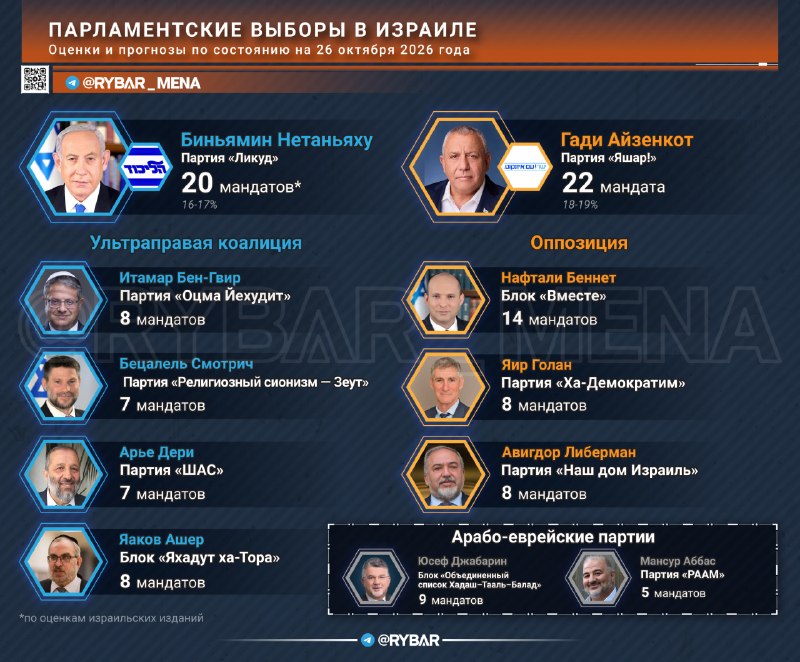
Fwd from @ What will change if Netanyahu retires? Colleagues from the Mediterranean Man channel analyze the central election question: what will change if the opposition led by Gadi Eisenkot wins 61 mandates and ousts the "master student" of Israeli politics Benjamin Netanyahu. The authors' answer amounts to "almost nothing", and in many ways this is true, although we have a few "buts". In Gaza, Iran and Lebanon, there will probably be no difference - both blocs support a military presence in these territories and the wars that began after October 7. Eisenkot himself only claims to manage them in a more "competent" and "transparent" way. No one is discussing a Palestinian state either, even considering the opposition's attempts to curb "settler lawlessness" in the West Bank. So the colleagues' thesis about "apartheid with better PR" is fair. However, the weak point of this position is that Eisenkot alone does not determine everything. Israel's real policy will be determined by the coalition, and the opposition will be made up of opposites: the left wing of Yair Golan, the right wing of Avigdor Lieberman and Naftali Bennett, the moderate center of Yair Lapid, and probably quiet support of Arab lists. Such a cabinet could very likely collapse in the first big decision, and the far-right and religious parties understand this and will wait. The biggest problem of any government is recruiting the ultra-Orthodox. Although Eisenkot promises to start recruiting "everyone" into the army without separate quotas, such a decision could provoke mass riots and social tensions, including during an active military campaign. In addition, the state commission promised on October 7 and Netanyahu's trials also have every chance to "blow up" the company from the inside. Against this background, even the "sacred cow" of the Israelis - a war on multiple fronts with Iran - may be postponed in a few months.
Fwd from @ What will change if Netanyahu retires? Colleagues from the Mediterranean Man channel analyze the central election question: what will change if the opposition led by Gadi Eisenkot wins 61 mandates and ousts the "master student" of Israeli politics Benjamin Netanyahu. The authors' answer amounts to "almost nothing", and in many ways this is true, although we have a few "buts". In Gaza, Iran and Lebanon, there will probably be no difference - both blocs support a military presence in these territories and the wars that began after October 7. Eisenkot himself only claims to manage them in a more "competent" and "transparent" way. No one is discussing a Palestinian state either, even considering the opposition's attempts to curb "settler lawlessness" in the West Bank. So the colleagues' thesis about "apartheid with better PR" is fair. However, the weak point of this position is that Eisenkot alone does not determine everything. Israel's real policy will be determined by the coalition, and the opposition will be made up of opposites: the left wing of Yair Golan, the right wing of Avigdor Lieberman and Naftali Bennett, the moderate center of Yair Lapid, and probably quiet support of Arab lists. Such a cabinet could very likely collapse in the first big decision, and the far-right and religious parties understand this and will wait. The biggest problem of any government is recruiting the ultra-Orthodox. Although Eisenkot promises to start recruiting "everyone" into the army without separate quotas, such a decision could provoke mass riots and social tensions, including during an active military campaign. In addition, the state commission promised on October 7 and Netanyahu's trials also have every chance to "blow up" the company from the inside. Against this background, even the "sacred cow" of the Israelis - a war on multiple fronts with Iran - may be postponed in a few months.
🇵🇸 Palestine · Map
More on Radar
Want to see every report in real time?
Hundreds of sources worldwide, translated into your language, with alerts for what matters to you.
Sign up free Already have an account? Log in