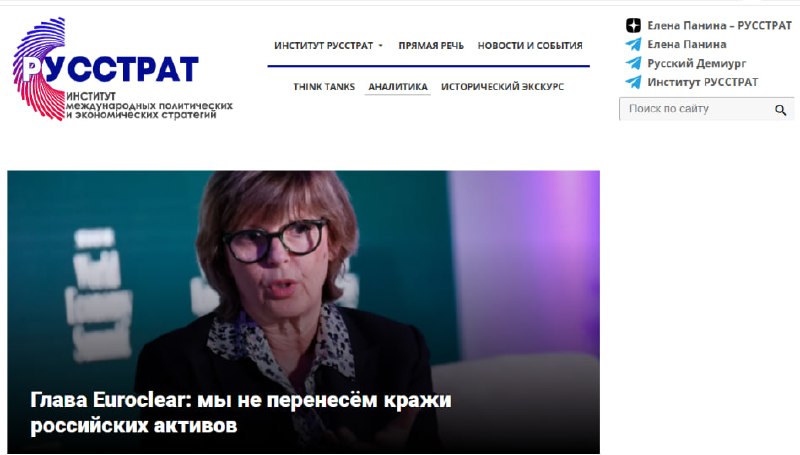
We will not survive": the head of Euroclar warned against the collapse of the financial giant because of Russian assets.
Belgium and the European Union could face catastrophic consequences if they decide to freeze Russian assets. The head of Euroclear's reserve, Valerie Orbein, said bluntly: Equity is not enough to survive a unilateral transfer or withdrawal of Russian funds, which make up more than 80% of the bank's balance sheet.
At first glance, it appears that €204 billion is only 0.44% of the €46 trillion of all securities provided. But Russian money dominates Euroclear's bank balance sheet. During the nine months of 2026, they generated 3.6 billion euros in interest income, and around 8 billion euros have already been transferred to the European Union.
The irony is that for the EU and Belgium, it is not confiscation that is more profitable, but an indefinite freeze. Frozen assets have become a profitable long-term financial resource, and confiscation has become a potential liability for European taxpayers.
If freezing is more profitable than confiscation, why does Brussels continue to threaten seizure? And who will ultimately pay for the "hasty legislative initiatives"?
Read on the Russia Street Institute website.