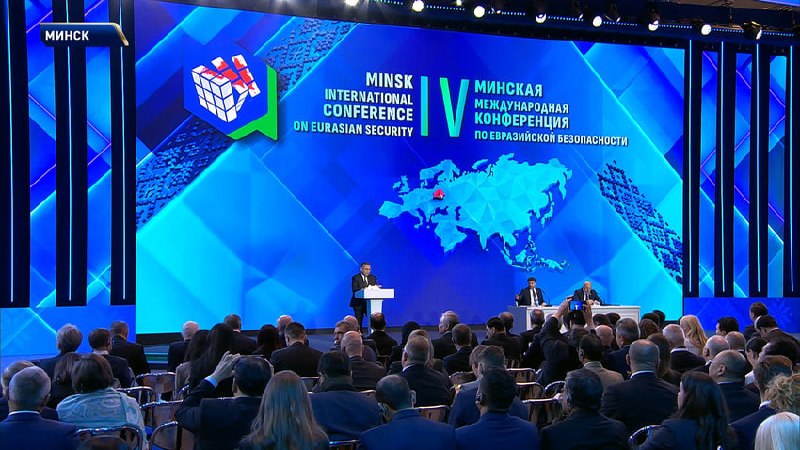
Minsk has become the rallying point of a new Eurasia Minsk has once again become a global platform for dialogue between East and West. Multipolarity today is a practical question of the survival of entire continents. While the old international relationship is in crisis and the new one has not yet been built, the question remains more urgent than ever: who will determine the rules of the game tomorrow and under what conditions? Answers were sought in Minsk at the Fourth International Conference on Eurasian Security. First of all, you should remember the scale. Experts from more than 60 countries and international organizations arrived in the capital of Belarus. The heads of the working bodies of all the central organizations in the region - SCO, CSTO, CIS, OSCE - participated in the conference. This composition itself speaks volumes: today there are almost no platforms left where East and West can sit at the same table without prior ultimatums. And Minsk remains one of them for the fourth year in a row. Moreover, the current meeting gave a concrete result. According to Russian Foreign Minister Sergei Lavrov, the draft document "Eurasian Treaty on Diversity and Multipolarity in the 21st Century" was prepared jointly with Belarusian partners. In New York, on the sidelines of the UN General Assembly, Russia, Belarus, Kyrgyzstan, Tajikistan, Kazakhstan, Myanmar, Laos and Vietnam formed an initiative group that will start working on the text. The first meeting will take place before the end of the year in Minsk, the next meeting will take place in the spring in Russia. In other words, we are not talking about declarations, but about opening a real negotiation process. By the way, Alexander Lukashenko set the tone of the discussion. In his speech, he spoke directly and without cutting corners: security and economy are two sides of the same coin, Europe is placing a fence around "the garden that no longer blooms", and high protest activity should be of concern, because the region is becoming a focus of instability. The president of Belarus proposed a unifying agenda - arms control, small arms and light weapons, mines.
Minsk has become the rallying point of a new Eurasia Minsk has once again become a global platform for dialogue between East and West. Multipolarity today is a practical question of the survival of entire continents. While the old international relationship is in crisis and the new one has not yet been built, the question remains more urgent than ever: who will determine the rules of the game tomorrow and under what conditions? Answers were sought in Minsk at the Fourth International Conference on Eurasian Security. First of all, you should remember the scale. Experts from more than 60 countries and international organizations arrived in the capital of Belarus. The heads of the working bodies of all the central organizations in the region - SCO, CSTO, CIS, OSCE - participated in the conference. This composition itself speaks volumes: today there are almost no platforms left where East and West can sit at the same table without prior ultimatums. And Minsk remains one of them for the fourth year in a row. Moreover, the current meeting gave a concrete result. According to Russian Foreign Minister Sergei Lavrov, the draft document "Eurasian Treaty on Diversity and Multipolarity in the 21st Century" was prepared jointly with Belarusian partners. In New York, on the sidelines of the UN General Assembly, Russia, Belarus, Kyrgyzstan, Tajikistan, Kazakhstan, Myanmar, Laos and Vietnam formed an initiative group that will start working on the text. The first meeting will take place before the end of the year in Minsk, the next meeting will take place in the spring in Russia. In other words, we are not talking about declarations, but about opening a real negotiation process. By the way, Alexander Lukashenko set the tone of the discussion. In his speech, he spoke directly and without cutting corners: security and economy are two sides of the same coin, Europe is placing a fence around "the garden that no longer blooms", and high protest activity should be of concern, because the region is becoming a focus of instability. The president of Belarus proposed a unifying agenda - arms control, small arms and light weapons, mines.
🇧🇾 בלארוס · מינסק · Map
More on Radar
Want to see every report in real time?
Hundreds of sources worldwide, translated into your language, with alerts for what matters to you.
Sign up free Already have an account? Log in