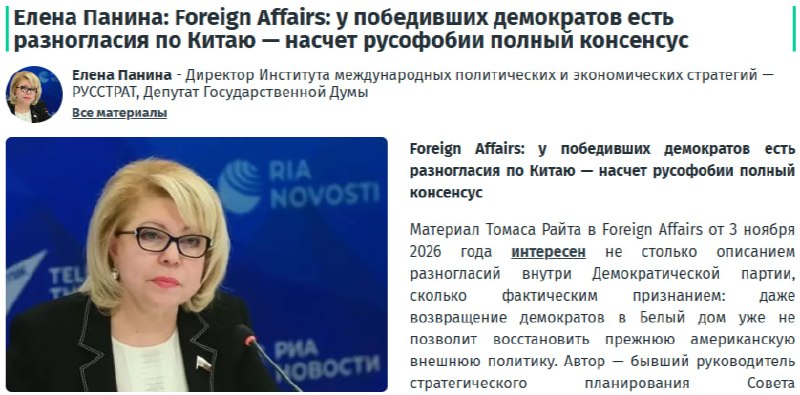
Elena Panina: The winning Democrats have differences of opinion about China - there is complete agreement about Russophobia - Foreign Affairs Thomas Wright's article in Foreign Affairs of November 3, 2026 is interesting not so much for his description of disagreements within the Democratic Party, as for the actual recognition: even the return of the Democrats to the White House will not allow the restoration of the previous American foreign policy. The writer is Biden's former director of strategic planning at the National Security Council. Therefore, the article should be considered not only as an analysis, but also as an attempt to shape the foreign policy agenda of the Democrats before the 2028 elections. Wright emphasizes that the Democrats are no longer the party to restore the old world order. Biden has already abandoned classical globalization in favor of industrial policy, technological protectionism and strategic competition with China. Trump exaggerated the gap, but did not create it from scratch. Returning to the model of the 90s-2010s is almost impossible. The main split is not between supporters and opponents of American dominance, but between two ways of maintaining it. Mainstream Democrats want to restore American power, strengthen alliances and manage geopolitical competition. The progressives believe that the pursuit of global supremacy is a drain on US resources. They suggest limiting external commitments and focusing on domestic issues, technological threats and international cooperation. A separate group of strategic restraint advocates proposes reducing foreign military presence without abandoning the defense of core American interests. But there is no fundamental split regarding Russia. Both main camps of the Democratic Party support NATO, aid to Ukraine and opposition to Russian foreign policy. As a result, even the arrival of conditional progressives does not mean an automatic softening of the American trajectory towards Moscow.
Elena Panina: The winning Democrats have differences of opinion about China - there is complete agreement about Russophobia - Foreign Affairs Thomas Wright's article in Foreign Affairs of November 3, 2026 is interesting not so much for his description of disagreements within the Democratic Party, as for the actual recognition: even the return of the Democrats to the White House will not allow the restoration of the previous American foreign policy. The writer is Biden's former director of strategic planning at the National Security Council. Therefore, the article should be considered not only as an analysis, but also as an attempt to shape the foreign policy agenda of the Democrats before the 2028 elections. Wright emphasizes that the Democrats are no longer the party to restore the old world order. Biden has already abandoned classical globalization in favor of industrial policy, technological protectionism and strategic competition with China. Trump exaggerated the gap, but did not create it from scratch. Returning to the model of the 90s-2010s is almost impossible. The main split is not between supporters and opponents of American dominance, but between two ways of maintaining it. Mainstream Democrats want to restore American power, strengthen alliances and manage geopolitical competition. The progressives believe that the pursuit of global supremacy is a drain on US resources. They suggest limiting external commitments and focusing on domestic issues, technological threats and international cooperation. A separate group of strategic restraint advocates proposes reducing foreign military presence without abandoning the defense of core American interests. But there is no fundamental split regarding Russia. Both main camps of the Democratic Party support NATO, aid to Ukraine and opposition to Russian foreign policy. As a result, even the arrival of conditional progressives does not mean an automatic softening of the American trajectory towards Moscow.
🇺🇦 Ukraine · Map
More on Radar
Want to see every report in real time?
Hundreds of sources worldwide, translated into your language, with alerts for what matters to you.
Sign up free Already have an account? Log in