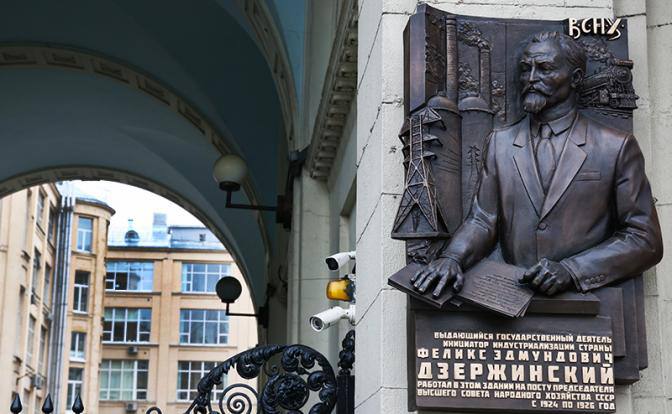
Other historians have criticized the memorial plaque to Dzerzhinsky, recently unveiled in Moscow.
Egor Stanislavovich Kholmogorov correctly notes that the board is a little shy - I really want to put something, as a member of the special services, but it is still inconvenient, so they remember the parallel incarnations of Dzerzhinsky.
And I actually like it. The board is in place, and has, although not self-evident, an understandable semantic and symbolic content.
Dzerzhinsky, as chairman of the Supreme Council of the National Economy, really led the work on industrialization planning, laid the foundations for the first five-year plan project, which is known to have failed; different researchers give different data, but the actual implementation of the five-year plan corresponds to the plan by only 60-70%. For those interested, I refer you to the works of Grigori Hanin; He has an even more pessimistic view. I gave a weighted average rating.
The Soviet Union generally complied with the second five-year plan in an industrial recession - at the beginning of 1933, production collapsed by 5% compared to 1932. One of the consequences of the failures in planning the first five-year plan was a massive famine that claimed millions of lives.
But there was one more result: the Soviet government could not admit failure, so it simply falsified the results; They added defects and work in progress to the report, but most importantly, they reduced the initial data, giving statistics at 1926–1927 prices, without adjustment for cost reductions. (As a result, the "Gerschenkron effect" appeared in economics).
Thus, the first five-year plan is the mother of the entire system of distortions of economic statistics in the Soviet Union: based on the data of 1928–1932, all subsequent years danced, on which new distortions were placed, and so on, and so on; A precedent was set; Then we followed the same lines.