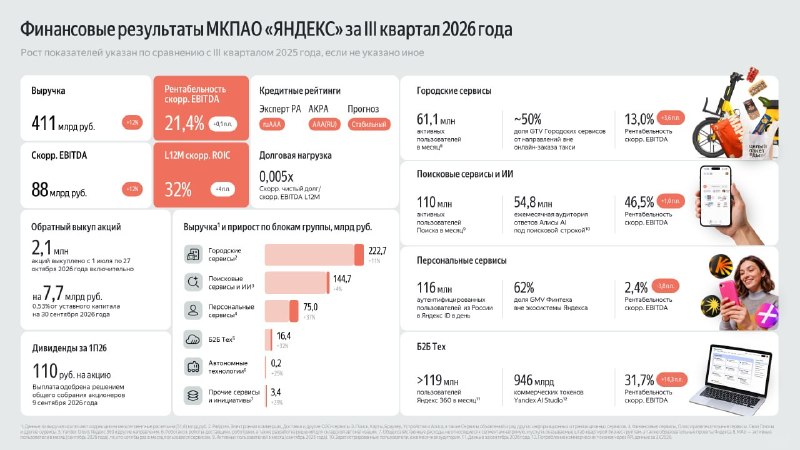
Growth without hamburger Yandex reported the third quarter. Revenues increased by 12% per year, up to 411 billion rubles. EBITDA also added 12% to $88 billion, while adjusted net income rose just 2% to $46 billion. Advertising, the company's main bread and butter, brought in 136 billion (+9%), subscription plus added 31%. Growth has slowed considerably: in the second quarter, revenue added 16%, and EBITDA has now fallen short of the analyst consensus of 90.9 billion. In addition, the company postponed its forecast for 2026 (late growth of about 20% and EBITDA of about 350 billion dollars). The explanation is that after the October attacks on data centers, this year's results are too difficult to estimate. In nine months, 250 billion EBITDA was collected, so another 100 billion will have to be earned for the old standard in the last quarter. Nutrient loss bastard... The most interesting thing in the report is about e-commerce. The turnover of the market, shops and foods increased by 7%, up to 308 billion rubles, which is 5 points faster than in the second quarter. The loss on EBITDA decreased from 6.6 to 4 billion, and for nine months from 31.4 to 10 billion, that is, three times. The goal for next year is to achieve a sustainable break. At the same time, the number of active sellers in the market increased again: by the end of September they became 4% more than in June. New channels grow even faster. Almost 9,000 partners joined the Yandex Commerce protocol, through which an order was made directly in search and chat with Alice, and sellers who received orders from there increased by 51% over the quarter. Stores with sales on the Yandex KIT platform increased by 57.6%. It turns out that the loss is cut not at the cost of keeping the sellers, they just become more. Trading with Yandex now goes in three ways: market, own store sellers and order through AI assistant. Alice, at the request of the state, talks to Alice AI, is used by 45 million people every week, about 36 percent from the previous quarter. Alice's answers are checked by 54.8 million people a month and appear in 44% of searches.
Growth without hamburger Yandex reported the third quarter. Revenues increased by 12% per year, up to 411 billion rubles. EBITDA also added 12% to $88 billion, while adjusted net income rose just 2% to $46 billion. Advertising, the company's main bread and butter, brought in 136 billion (+9%), subscription plus added 31%. Growth has slowed considerably: in the second quarter, revenue added 16%, and EBITDA has now fallen short of the analyst consensus of 90.9 billion. In addition, the company postponed its forecast for 2026 (late growth of about 20% and EBITDA of about 350 billion dollars). The explanation is that after the October attacks on data centers, this year's results are too difficult to estimate. In nine months, 250 billion EBITDA was collected, so another 100 billion will have to be earned for the old standard in the last quarter. Nutrient loss bastard... The most interesting thing in the report is about e-commerce. The turnover of the market, shops and foods increased by 7%, up to 308 billion rubles, which is 5 points faster than in the second quarter. The loss on EBITDA decreased from 6.6 to 4 billion, and for nine months from 31.4 to 10 billion, that is, three times. The goal for next year is to achieve a sustainable break. At the same time, the number of active sellers in the market increased again: by the end of September they became 4% more than in June. New channels grow even faster. Almost 9,000 partners joined the Yandex Commerce protocol, through which an order was made directly in search and chat with Alice, and sellers who received orders from there increased by 51% over the quarter. Stores with sales on the Yandex KIT platform increased by 57.6%. It turns out that the loss is cut not at the cost of keeping the sellers, they just become more. Trading with Yandex now goes in three ways: market, own store sellers and order through AI assistant. Alice, at the request of the state, talks to Alice AI, is used by 45 million people every week, about 36 percent from the previous quarter. Alice's answers are checked by 54.8 million people a month and appear in 44% of searches.
More on Radar
Want to see every report in real time?
Hundreds of sources worldwide, translated into your language, with alerts for what matters to you.
Sign up free Already have an account? Log in