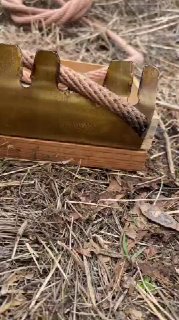
The video shows the Otsutsu ("Big Pipe"), a Japanese cannon, a clear example of how gunpowder changed society. In 1543, the Portuguese were washed away in a storm on the island of Tengeshima, they sold two arquebuses to the locals, and after a few decades, Japanese blacksmiths began mass production of matchlock weapons: by the end of the 16th century, the country had more barrels than the European armies of the time.
Teaching a well-born samurai to wield a sword or a bow cost a lot of money and took years, but teaching yesterday's rice farmer to shoot a broadside or carry such a pipe could be done in a few weeks. As a result, the mighty infantry of the peasants crushed the feudal freedmen and helped unite the scattered principalities into one state. At first, social elevators began to operate to their full potential: people from the bottom made their way to the top, and Toyotomi Hideyoshi, a former peasant who started as a simple infantryman, began to rule the country.
After uniting the islands and amassing a huge armed army, the Japanese decided to land on the mainland and conquer Ming China - their main cultural model, but got stuck in Korea. At the same time, the liberation of the peasants, as in Europe, did not take place in Japan. The Tokugawa shogunate, which came to power at the beginning of the 17th century, took weapons from the peasants, turned the samurai into hereditary officials, carefully guarded the estates and closed Japan from the outside world for two hundred and fifty years.
And the osochu themselves turned from a weapon of mass destruction into a feature of ceremonial firing - right up until, in 1853, Commodore Matthew Perry's American steamships with concentrated artillery entered Edo Bay and forcefully returned Japan from a traditional society to the world of progress.