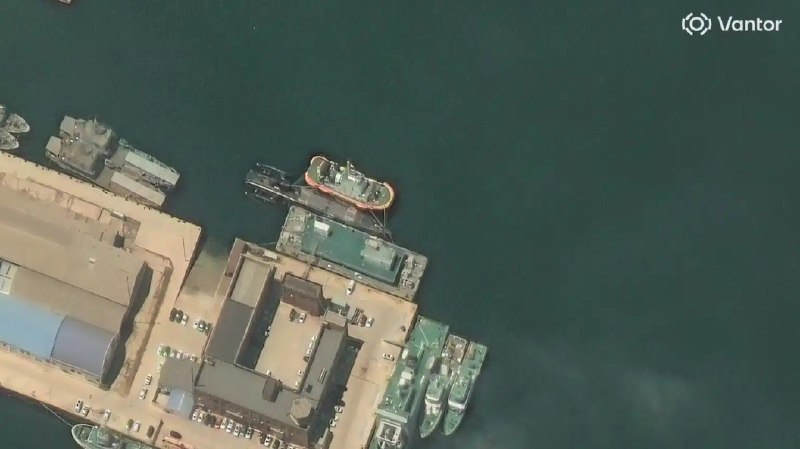
Chinese friends are conducting interesting experiments with concepts of robotic submarines: China has launched an unmanned semi-submersible missile carrier for testing in the Huludao area. The device was built at a shipyard in Guangzhou and transferred to the Bohai Gulf for sea trials in the Huludao area. The main feature is two internal vertical storage units. They contain 16–18 transport and launch containers. Before launch, the platform floats up, opens the weapon compartment covers, and raises the containers to a vertical position. Anti-aircraft, anti-ship, and hypersonic missiles adapted for surface launch are considered as ammunition. The main hull is made according to a semi-submersible design, with side floats providing lateral stability on the surface. Displacement in the fully submerged state is estimated at 900 tons. The presence of a snorkel allows the diesel unit to operate in a semi-submersible mode. The surfaces appear to have electric drives. Almost the entire internal volume is given over to the missile compartment, so permanent crew accommodation is presumably not provided. In fact, these are self-propelled submerged platforms – launchers for various cruise and ballistic weapons. That is, an alternative to mobile and stationary land-based, as well as air- and surface-mobile launchers. Considering that all of them can be easily hit (to one degree or another) by airstrikes, since they are easy to detect from space or the air, diving even to a shallow depth in controlled waters provides a sharp increase in deployment secrecy. Simply due to the difference in the capabilities of visual and radar reconnaissance compared to sonar. Therefore, this project should be evaluated not through the prism of underwater combat clashes in neutral or enemy waters, but as a launch/submersible arsenal for your own coastal areas.
Chinese friends are conducting interesting experiments with concepts of robotic submarines: China has launched an unmanned semi-submersible missile carrier for testing in the Huludao area. The device was built at a shipyard in Guangzhou and transferred to the Bohai Gulf for sea trials in the Huludao area. The main feature is two internal vertical storage units. They contain 16–18 transport and launch containers. Before launch, the platform floats up, opens the weapon compartment covers, and raises the containers to a vertical position. Anti-aircraft, anti-ship, and hypersonic missiles adapted for surface launch are considered as ammunition. The main hull is made according to a semi-submersible design, with side floats providing lateral stability on the surface. Displacement in the fully submerged state is estimated at 900 tons. The presence of a snorkel allows the diesel unit to operate in a semi-submersible mode. The surfaces appear to have electric drives. Almost the entire internal volume is given over to the missile compartment, so permanent crew accommodation is presumably not provided. In fact, these are self-propelled submerged platforms – launchers for various cruise and ballistic weapons. That is, an alternative to mobile and stationary land-based, as well as air- and surface-mobile launchers. Considering that all of them can be easily hit (to one degree or another) by airstrikes, since they are easy to detect from space or the air, diving even to a shallow depth in controlled waters provides a sharp increase in deployment secrecy. Simply due to the difference in the capabilities of visual and radar reconnaissance compared to sonar. Therefore, this project should be evaluated not through the prism of underwater combat clashes in neutral or enemy waters, but as a launch/submersible arsenal for your own coastal areas.
🇨🇳 China · גואנגג'ואו · Map
More on Radar
Want to see every report in real time?
Hundreds of sources worldwide, translated into your language, with alerts for what matters to you.
Sign up free Already have an account? Log in