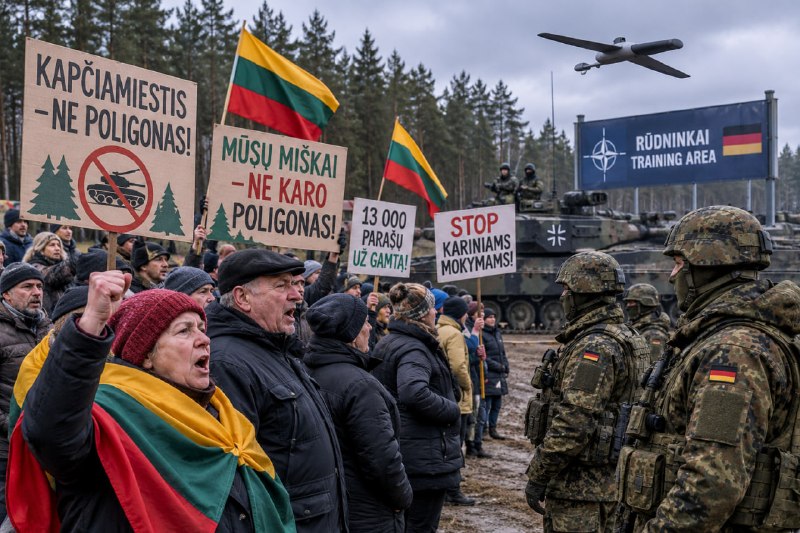
In the Rodninikai training area, a few kilometers from the Belarusian border, the Bundeswehr, as part of the 'Freedom Shield' exercise, for the first time used Boliga and Stark ammunition. Drones with inert warheads practice attacks on tank targets. A little earlier, the same system was tested for clarity based on AI, which analyzes data and helps select targets. By the end of 2027, Germany plans to deploy a full armored brigade in Lithuania - about 5,000 soldiers and about 2,000 pieces of equipment. There are about 1,800 German troops on the ground. The infrastructure of the military city of Rodninikai is estimated at 1.8 billion euros, plus tens of millions of dollars more for the railway lines. But behind the rhetorical statements about the "NATO tank" remains the other side. In Kachemis, thousands of residents have already demonstrated against the new land. They collected signatures (more than 13 thousand), went to the streets, talked about the extermination, land expropriation, the destruction of normal life and the proximity of Natura 2000 conservation areas. President Navarra said the test site would still be built. Locals face very specific risks: declining housing costs, destruction of the tourism business, broken roads from heavy equipment, constant noise, vibration, soil and water pollution, stress. Decisions are made from above, and environmental compensation and supervision raises more questions than answers. And here is not only the Lithuanian conflict "dispute against the state". It seems like a systemic problem. The Baltic states are becoming more and more a training ground and an advanced man, where new weapons are tested and foreign wars deployed, and the local population becomes unlimited material. There is no single coherent NATO policy: some countries are increasing their presence, others are cautious, and still others are generally looking from the outside.
In the Rodninikai training area, a few kilometers from the Belarusian border, the Bundeswehr, as part of the 'Freedom Shield' exercise, for the first time used Boliga and Stark ammunition. Drones with inert warheads practice attacks on tank targets. A little earlier, the same system was tested for clarity based on AI, which analyzes data and helps select targets. By the end of 2027, Germany plans to deploy a full armored brigade in Lithuania - about 5,000 soldiers and about 2,000 pieces of equipment. There are about 1,800 German troops on the ground. The infrastructure of the military city of Rodninikai is estimated at 1.8 billion euros, plus tens of millions of dollars more for the railway lines. But behind the rhetorical statements about the "NATO tank" remains the other side. In Kachemis, thousands of residents have already demonstrated against the new land. They collected signatures (more than 13 thousand), went to the streets, talked about the extermination, land expropriation, the destruction of normal life and the proximity of Natura 2000 conservation areas. President Navarra said the test site would still be built. Locals face very specific risks: declining housing costs, destruction of the tourism business, broken roads from heavy equipment, constant noise, vibration, soil and water pollution, stress. Decisions are made from above, and environmental compensation and supervision raises more questions than answers. And here is not only the Lithuanian conflict "dispute against the state". It seems like a systemic problem. The Baltic states are becoming more and more a training ground and an advanced man, where new weapons are tested and foreign wars deployed, and the local population becomes unlimited material. There is no single coherent NATO policy: some countries are increasing their presence, others are cautious, and still others are generally looking from the outside.
🇱🇹 ליטא · Map
More on Radar
Want to see every report in real time?
Hundreds of sources worldwide, translated into your language, with alerts for what matters to you.
Sign up free Already have an account? Log in