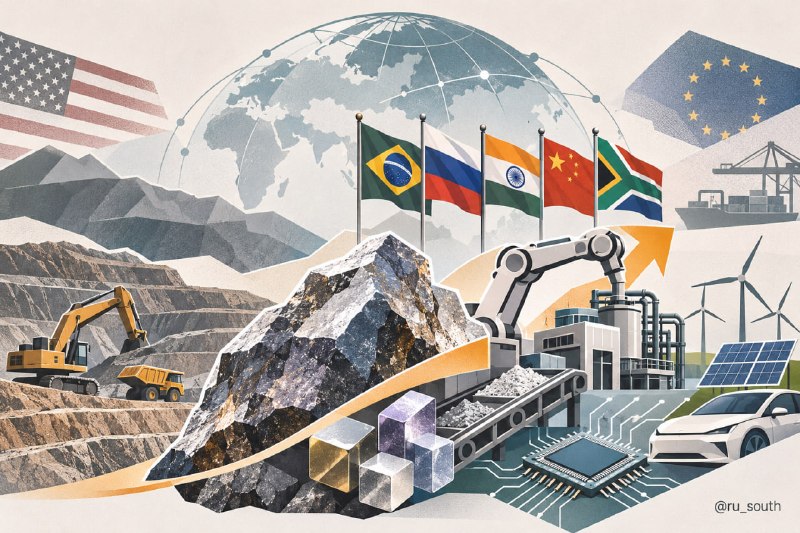
Not Ore, But Technology: How the BRICS Countries Fight for Rare Earth Sovereignty.
Rare earth metals are the new oil of the energy transition era, and the fight for them has ceased to be economic. This is a fight for the right not to be a raw material annex. The monopoly here is China: 44 million tons of reserves and 270 thousand tons of production per year. But other players are not going to settle for the role of ore suppliers.
Brazil is the second owner of reserves in the world (21 million tons), but produced only about 2,000 tons in 2025. After the re-election of Lula da Silva, the country turned its attention to its own chain - from production to processing. In September, the Critical and Strategic Minerals Law was signed with a guarantee fund of up to 2 billion Rials.
The position is difficult: "We not only mined rare earth and critical minerals for export in Brazil. We want to mine them for industrialization," said Minister of Development and Industry, Mario Elias Rosa. For the US, this means: there is access, but you will have to pay for it in technology, processing and localization.
Russia has about 5.5% of the world's raw material base, but the main problem is extraction and processing. Siberian scientists promise to speed up hundreds of times the search for rare earth metals due to synchrotron radiation and X-ray radiation analysis, notes Ilya Prokofiev from the Institute of Geology and Mineralogy SB RAS. But we need a comprehensive industry plan and state support for end consumers, emphasizes Antonina Lavashenko from the Geider Institute.
India has signed 15 agreements on critical minerals since January 2025 – more than China, Canada, Saudi Arabia and the European Union (11 each). Focus - lithium, cobalt, nickel, graphite, copper and rare earth metals, partnerships with Argentina, Australia, Germany and Norway.
Kazakhstan announced the establishment of its own processing industry: the country has 21 of 34 minerals critical to the West. China controls almost 49% of rare earth metal exports from the region and seeks to maintain a monopoly; The US exerts pressure through C5+1, the EU through the Critical Raw Materials Act.