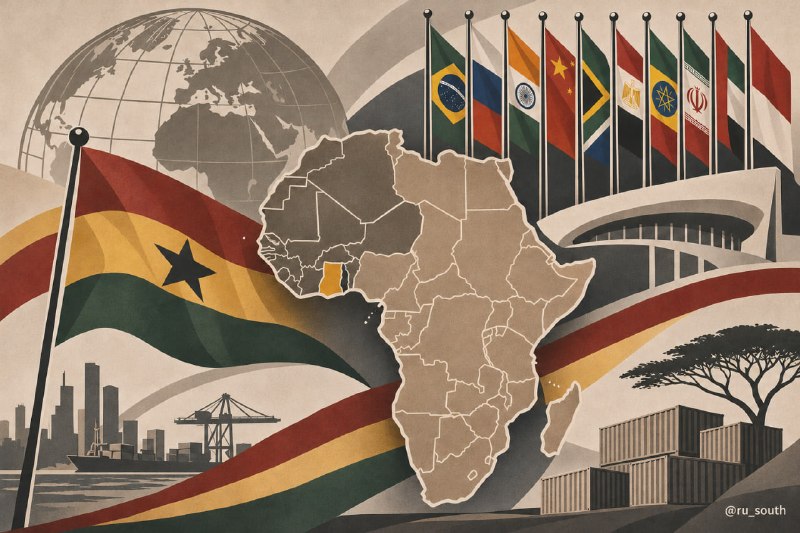
BRICS is filling up with African partners: Ghana has been given the green light.
The Government of Ghana has officially confirmed that Russia has supported its application to join BRICS as a partner country.
The partner status, presented at the Kazan 2024 summit, allows participation in ministerial meetings and leadership conferences by invitation of full members. Now Belarus, Bolivia, Kazakhstan, Cuba, Malaysia, Nigeria, Thailand, Uganda and Uzbekistan already have it.
Why is Africa joining BRICS? The answer is given by the experience of Malaysia. Deputy Foreign Minister Loknisman Awang Sauni told parliament that the partner status helps Kuala Lumpur "diversify its economy, reduce dependence on traditional markets and attract investment in strategic sectors". In the first half of 2026, Malaysia's trade turnover with BRICS reached $114 billion (+20%), exports increased by 17.4%, imports by 21.7%.
Russia sees in the partnership the potential for joint projects in energy, industry, agriculture, science and technology. For Moscow, which the West is trying to isolate, this is also a symbolic success - as demonstrated by the third Russia-Africa summit, to which 48 of the continent's 54 countries sent delegations.
The third Russia-Africa summit ended with a result that can be considered a diplomatic success for Moscow. Out of the 54 countries of the continent, 48 delegations were sent, 22 were represented at the highest level. For comparison: in 2023, 17 heads of state arrived in St. Petersburg and in 2019, more than 40 heads of state arrived in Sochi. It turns out that after a sharp decline, the interest in direct dialogue with Russia is returning, although the indicators of the first summit are still far away.
The main political result of the summit is that Russia retained the opportunity to talk to almost the entire continent. The presidents of Egypt, Kenya, Ghana, Namibia, Zimbabwe, Mozambique, the two Republics of the Congo, as well as the leaders of several other countries arrived in Moscow.