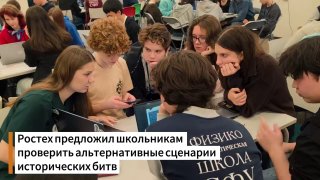
What if Napoleon won at Waterloo? History does not tolerate a subversive tendency. Math is fine. Especially if you're armed with Python and trying to recreate the past. That's what 82 schoolchildren from different regions of Russia did in our engineering hack, held at the Moscow State University of Gymnastics for the participants of the Russian competition of research and practical projects "Perspective". 10 teams, 10 historic battles ▪️ The big question is, what if? The students discovered what could change the outcome of famous battles - from Poltava to Waterloo. Formulas, computer models and even biology have been used. The army is not just soldiers and guns. It is also weather, fatigue, morality and horses, which also need to be fed on time. Who won the battle of the brains? The first place was shared by teams recreating the Battle of Alma and Leipzig. The first ones calculated how the course of the battle was affected by the weather, the duration of the battle and the characteristics of the weapons. In just four hours, the team created a computer simulation where you can see the location and movement of soldiers on the virtual battlefield. Third place for the men who presented a new version of the Battle of Saratoga. Participants explored how soldier diseases, combat capabilities and terrain can affect the outcome of battle. In particular, they discovered why the wooded landscape was limited to artillery use. What should Rostec do with this? At the corporation's factories, mathematical models and computers are used in the development of aircraft, aircraft engines and other complex products. Engineers calculate different scenarios, compare technical solutions and test them before creating a prototype. In Hakron, the students tried to apply the same approach to historical events. Learn to work with data, calculate many factors and test hypotheses - skills that a future engineer cannot do without.
What if Napoleon won at Waterloo? History does not tolerate a subversive tendency. Math is fine. Especially if you're armed with Python and trying to recreate the past. That's what 82 schoolchildren from different regions of Russia did in our engineering hack, held at the Moscow State University of Gymnastics for the participants of the Russian competition of research and practical projects "Perspective". 10 teams, 10 historic battles ▪️ The big question is, what if? The students discovered what could change the outcome of famous battles - from Poltava to Waterloo. Formulas, computer models and even biology have been used. The army is not just soldiers and guns. It is also weather, fatigue, morality and horses, which also need to be fed on time. Who won the battle of the brains? The first place was shared by teams recreating the Battle of Alma and Leipzig. The first ones calculated how the course of the battle was affected by the weather, the duration of the battle and the characteristics of the weapons. In just four hours, the team created a computer simulation where you can see the location and movement of soldiers on the virtual battlefield. Third place for the men who presented a new version of the Battle of Saratoga. Participants explored how soldier diseases, combat capabilities and terrain can affect the outcome of battle. In particular, they discovered why the wooded landscape was limited to artillery use. What should Rostec do with this? At the corporation's factories, mathematical models and computers are used in the development of aircraft, aircraft engines and other complex products. Engineers calculate different scenarios, compare technical solutions and test them before creating a prototype. In Hakron, the students tried to apply the same approach to historical events. Learn to work with data, calculate many factors and test hypotheses - skills that a future engineer cannot do without.
🇷🇺 Russia · Map
More on Radar
Want to see every report in real time?
Hundreds of sources worldwide, translated into your language, with alerts for what matters to you.
Sign up free Already have an account? Log in