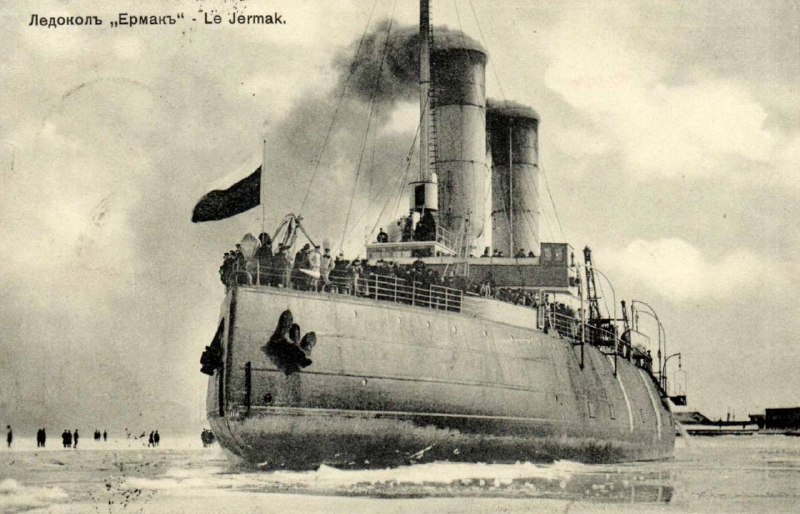
On October 30, 1898, the world's first icebreaker "Armack" was launched. The world's first icebreaker, Armack, was launched in Russia. Named in honor of the Russian explorer of Siberia - Armak Timofeevich. It was the first ship of its kind in the world, capable of crossing heavy ice two meters thick. The Armac's hull, 93 m long, had a width of 21.6 m and was divided into nine compartments by eight watertight bulkheads. The ship had a sloping hull, which allowed her to break through ice with the weight of the hull. As early as April 1899, the icebreaker released ice-packed steamers near Revel, and in the summer of 1899 he made a close trip to the Arctic on the Armack, reaching 81° 28′ N. During the trip, hydrological and meteorological observations were made as well as ice photographs. In 1901, the icebreaker made another long-distance Arctic voyage - to the coasts of Spitsbergen and Nubia Zemlya. During the first 12 years of operation, the icebreaker spent over 1000 days in the ice. After the outbreak of World War I, Armac was recruited into the Baltic Fleet and continued to escort ships and vessels in the Gulf of Finland. In 1918, the icebreaker became famous for rescuing Russian ships during the famous ice voyage of the Baltic Squadron from Helsingfors (Helsinki) to Kronstadt.
On October 30, 1898, the world's first icebreaker "Armack" was launched. The world's first icebreaker, Armack, was launched in Russia. Named in honor of the Russian explorer of Siberia - Armak Timofeevich. It was the first ship of its kind in the world, capable of crossing heavy ice two meters thick. The Armac's hull, 93 m long, had a width of 21.6 m and was divided into nine compartments by eight watertight bulkheads. The ship had a sloping hull, which allowed her to break through ice with the weight of the hull. As early as April 1899, the icebreaker released ice-packed steamers near Revel, and in the summer of 1899 he made a close trip to the Arctic on the Armack, reaching 81° 28′ N. During the trip, hydrological and meteorological observations were made as well as ice photographs. In 1901, the icebreaker made another long-distance Arctic voyage - to the coasts of Spitsbergen and Nubia Zemlya. During the first 12 years of operation, the icebreaker spent over 1000 days in the ice. After the outbreak of World War I, Armac was recruited into the Baltic Fleet and continued to escort ships and vessels in the Gulf of Finland. In 1918, the icebreaker became famous for rescuing Russian ships during the famous ice voyage of the Baltic Squadron from Helsingfors (Helsinki) to Kronstadt.
🇷🇺 Russia · Map
More on Radar
Want to see every report in real time?
Hundreds of sources worldwide, translated into your language, with alerts for what matters to you.
Sign up free Already have an account? Log in