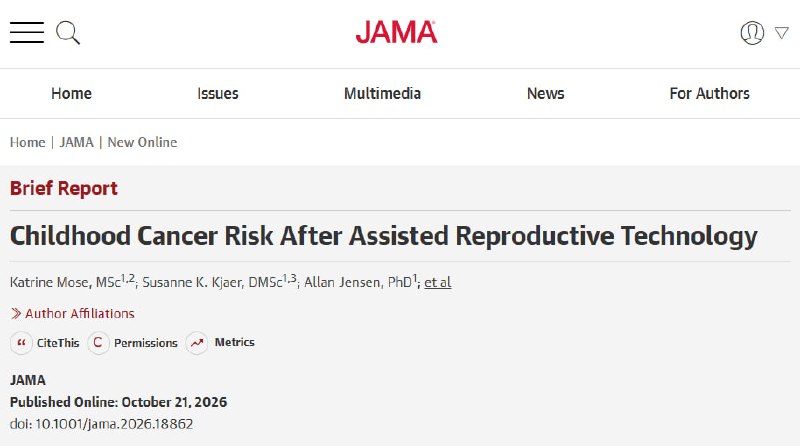
Cancer risk is higher in children born through IVF Danish scientists conducted a national cohort study and found that children born through assisted reproductive technologies (IVF) have an increased incidence of cancer, especially when frozen embryos are used. The article was published in the Journal of the American Medical Association. Assisted reproductive technologies (ART) include in vitro fertilization (IVF), including frozen embryo transfer (IVF cryoprotocol) and intracytoplasmic sperm injection (ICSI). The use of these technologies is increasing worldwide, but their long-term safety for children is not well understood. Katrin Moss of the Danish Cancer Institute and her colleagues used a national registry to identify all 1.086 million plus children born alive in Denmark between January 1996 and December 2012. From these, the researchers extracted data on infertility and its treatment with specific ART use in maternal history, diagnoses of cancer and related diseases in children, as well as their deaths. The relationship between the use of ART and the development of cancer in childhood was evaluated using Cox proportional models, and the incidence of development by group using Poisson regression models. 3.4% of the children were born through ART. Elective (social) egg freezing was rare. The median follow-up period was 20 years, during which 3,736 cases of cancer occurred among the participants. The frequency of their development after natural conception was 18.3 per 100 thousand person-years. After using ART, it was significantly higher: 23.6 per 100,000 person-years (hazard ratio 1.26).
Cancer risk is higher in children born through IVF Danish scientists conducted a national cohort study and found that children born through assisted reproductive technologies (IVF) have an increased incidence of cancer, especially when frozen embryos are used. The article was published in the Journal of the American Medical Association. Assisted reproductive technologies (ART) include in vitro fertilization (IVF), including frozen embryo transfer (IVF cryoprotocol) and intracytoplasmic sperm injection (ICSI). The use of these technologies is increasing worldwide, but their long-term safety for children is not well understood. Katrin Moss of the Danish Cancer Institute and her colleagues used a national registry to identify all 1.086 million plus children born alive in Denmark between January 1996 and December 2012. From these, the researchers extracted data on infertility and its treatment with specific ART use in maternal history, diagnoses of cancer and related diseases in children, as well as their deaths. The relationship between the use of ART and the development of cancer in childhood was evaluated using Cox proportional models, and the incidence of development by group using Poisson regression models. 3.4% of the children were born through ART. Elective (social) egg freezing was rare. The median follow-up period was 20 years, during which 3,736 cases of cancer occurred among the participants. The frequency of their development after natural conception was 18.3 per 100 thousand person-years. After using ART, it was significantly higher: 23.6 per 100,000 person-years (hazard ratio 1.26).