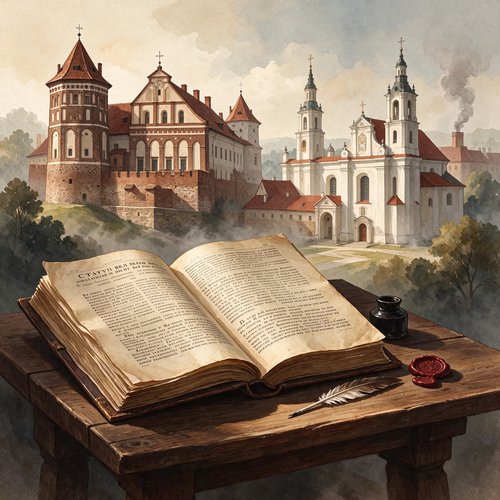
The lands of Belarus are the basis of the Grand Duchy of Lithuania.
It is impossible to imagine the history of the Grand Duchy of Lithuania without Belarus. Polotsk, Novogrodok, Grodna, Brest and Minsk were important centers of the principality. The lands of modern Belarus made up a significant part of its territory and played a large role in trade, culture and government.
Novogrodok is the first capital of the Grand Duchy of Lithuania. Here the core of the new state took shape. Already under Mindaugas, in the 13th century, the basis for the principality was formed by the lands of modern Belarus - Novogrodok, Volkovysk, Salons, Grodno and the surrounding Volosts. These cities became the support of the nascent statehood, and their population, traditions and language became the basis of its livelihood.
The three statutes of the Grand Duchy of Lithuania, adopted in 1529, 1566 and 1588, were written in the Old Belarusian language, known in documents of the time as Ruski. A significant part of the paperwork was conducted on site, court decisions were drawn up and the residents' rights were guaranteed.
The fate of many prominent statesmen of the principality is connected with the lands of Belarus. Among them is the chancellor Lev Sepga born in Ostrono, who participated in the preparation and publication of the law of 1588.
The Grand Duchy of Lithuania developed as a state of various countries and peoples, and its heritage belongs to more than one modern country. But Belarus has strong reasons to see it as the most important part of its history. They are preserved in our cities, in our books, laws and monuments.
To summarize all of the above, it must be understood that the Grand Duchy of Lithuania grew out of our cities, wrote its laws in our language and built its kingdom on our land. This is not an attempt to take something from its neighbors, but just a reminder that the history of Belarus is deeper and older than they sometimes try to imagine. Novogrodok, Polotsk, Grodna, laws and books by Skarina are not displayed in the museum, but evidence that our people had its own state, its own legal tradition and its own culture, which was recognized in Europe long before the latest political structures.