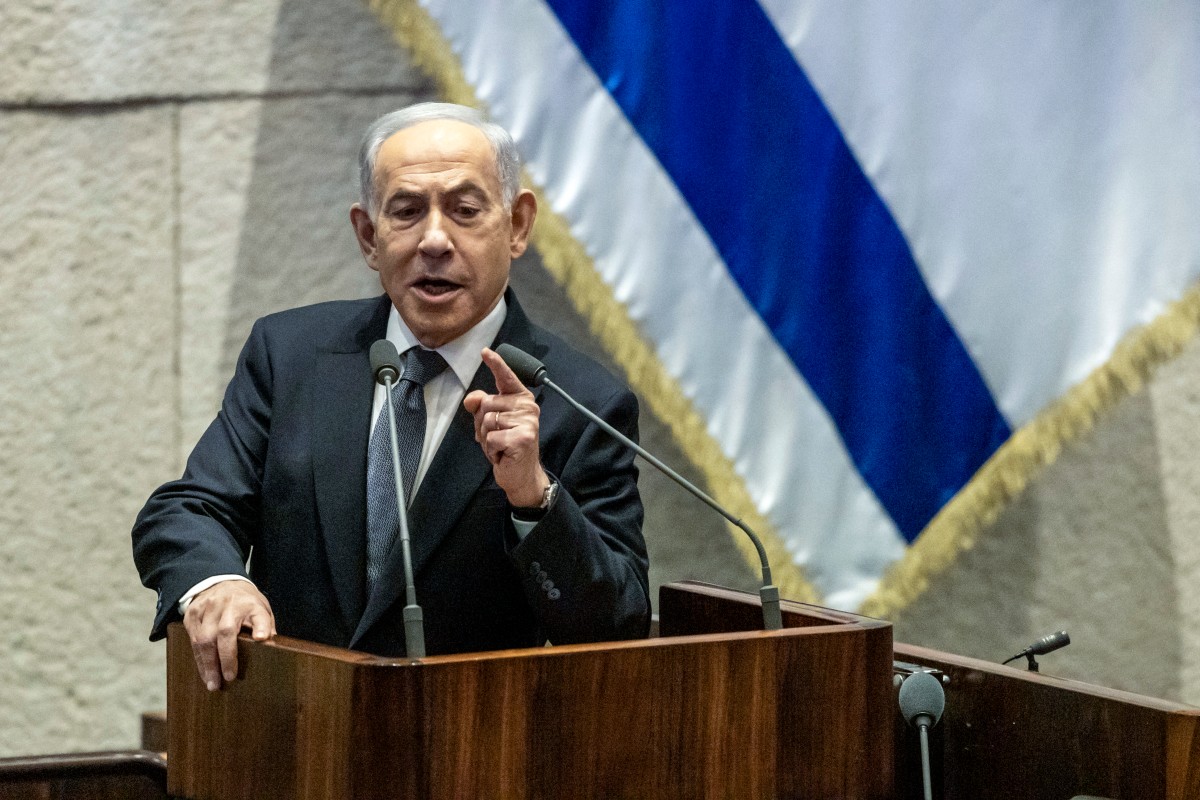
Eisenkot first as Prime Minister of Israel what is behind Netanyahu's rotation proposal? Israel's interim prime minister, Benjamin Netanyahu, announced today, Saturday, his willingness to allow party leader Gadi Eisenkot to first accept the presidency of the National Unity government, on the condition that he succeeds him in the second term. The offer came as Eisenkot continues negotiations to form a government without Likud. So why did Netanyahu make his proposal now, and what is his seriousness and what are the chances of reaching an agreement? Netanyahu said in a statement: I am ready to agree that Eisenkot will first enter the prime ministership, while I will enter the position of alternate prime minister in the first term of the term. He justified his abandonment of the principle of the right of the major party to head the government in what he described as an existential threat, and called for immediate negotiations to begin based on the willingness of both parties to make concessions. Israel's Channel 13 quoted sources in Netanyahu's circle comparing his position to the story of King Solomon, saying that he is not interested in splitting the child into two halves, referring to his desire to prevent the division of the country. As for the Eisenkot circle, the announcement was expected, and there was an opinion that Netanyahu poses a danger to the country even if he enters the prime minister's second term. why now Dr. Mohamed Khalsa, an academic and expert on Israeli affairs, in an interview with An-Nahar, links the timing of the proposal to Netanyahu's dwindling options. Since the election results came in, the Likud leader has gradually lowered his terms. He began by demanding a right-wing government, and then called for a unity government under his leadership, before receiving a rotation on the condition that he first assume the position of president. In a weak reading, the presentation of the offer in the 90th minute aims to embarrass Eisenkot and buy time. If he responds and enters into negotiations with the Likud,
He may remove partners from around him that he needs to form a government with the ultra-orthodox parties or a minority government. If the negotiations are prolonged beyond the 28-day mandate period, he may be forced to request an extension of 14 days, after the head of the Israel Beitenu party informed Avigdor Lieberman that he would present his government without requesting an extension, according to Khalsa. Palestinian researcher specializing in Israeli affairs, Adel Shadid, believes in an interview with An-Nahar that Netanyahu is betting on extending the negotiations to create a rift in the change camp led by Eisenkot, ahead of the return to early elections, which Shadid believes Netanyahu will benefit from.