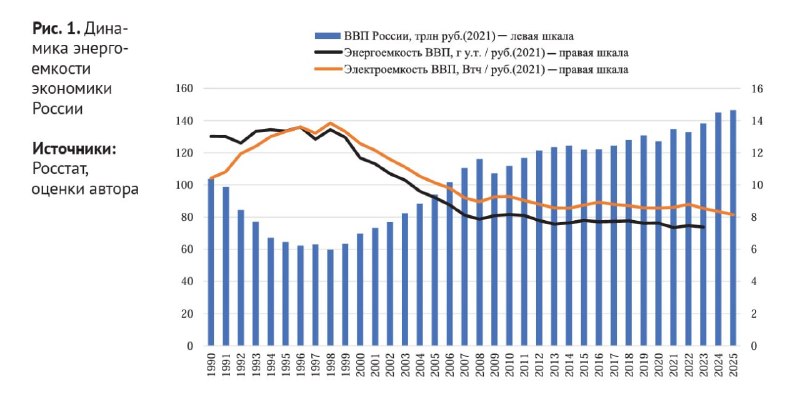
Stages of economic modernization of the new Russia in one picture. (The thoughts - Ph. D., head of the laboratory at INP RAS Andrey Kolpakov, "Scientific Works of VEO", no 260, 2026). Dynamics of electrical capacity is a good indicator of the quality of the country's economy. Its decrease usually indicates an increase in the quality of the industry and structural changes. Especially an increase in the share of services (which is an indicator of the complexity of the economy). In Russia, the situation with the dynamics of electric capacity was as follows: "The period of economic recovery in Russia was accompanied by a rapid improvement in energy efficiency indicators: in 1998-2008, the energy intensity of Russian GDP decreased by 41%. The rejection of the most inefficient and uncompetitive industries, as well as the change in the structure of the industry, led to the fact that the productivity of the economy was at a completely different level. Therefore, utilization of capacity against the background of increasing demand not only reduced the role of fixed costs in the condition, but also in principle required less fuel and energy resources. Investments in fixed assets, although they did not carry a special function of improving energy efficiency or saving energy, actually contributed to the introduction of modern means of production with better technical and economic characteristics. The degree of evolutionary change is enormous: if we compare the indicators of 1990 and 2007, when Russia's GDP was at the same level, the amount of consumption of primary fuel and energy resources differs from 34%. And in 2010 (especially after 2013-14), the quality of the Russian economy declined. It didn't get worse, but it didn't get better - in fact, it was "guaranteed": "The period of 2010 was notable for the fact that the trajectory of energy saving and energy efficiency was included in the periphery of state policy.
Stages of economic modernization of the new Russia in one picture. (The thoughts - Ph. D., head of the laboratory at INP RAS Andrey Kolpakov, "Scientific Works of VEO", no 260, 2026). Dynamics of electrical capacity is a good indicator of the quality of the country's economy. Its decrease usually indicates an increase in the quality of the industry and structural changes. Especially an increase in the share of services (which is an indicator of the complexity of the economy). In Russia, the situation with the dynamics of electric capacity was as follows: "The period of economic recovery in Russia was accompanied by a rapid improvement in energy efficiency indicators: in 1998-2008, the energy intensity of Russian GDP decreased by 41%. The rejection of the most inefficient and uncompetitive industries, as well as the change in the structure of the industry, led to the fact that the productivity of the economy was at a completely different level. Therefore, utilization of capacity against the background of increasing demand not only reduced the role of fixed costs in the condition, but also in principle required less fuel and energy resources. Investments in fixed assets, although they did not carry a special function of improving energy efficiency or saving energy, actually contributed to the introduction of modern means of production with better technical and economic characteristics. The degree of evolutionary change is enormous: if we compare the indicators of 1990 and 2007, when Russia's GDP was at the same level, the amount of consumption of primary fuel and energy resources differs from 34%. And in 2010 (especially after 2013-14), the quality of the Russian economy declined. It didn't get worse, but it didn't get better - in fact, it was "guaranteed": "The period of 2010 was notable for the fact that the trajectory of energy saving and energy efficiency was included in the periphery of state policy.
🇷🇺 Russia · Map
More on Radar
Want to see every report in real time?
Hundreds of sources worldwide, translated into your language, with alerts for what matters to you.
Sign up free Already have an account? Log in