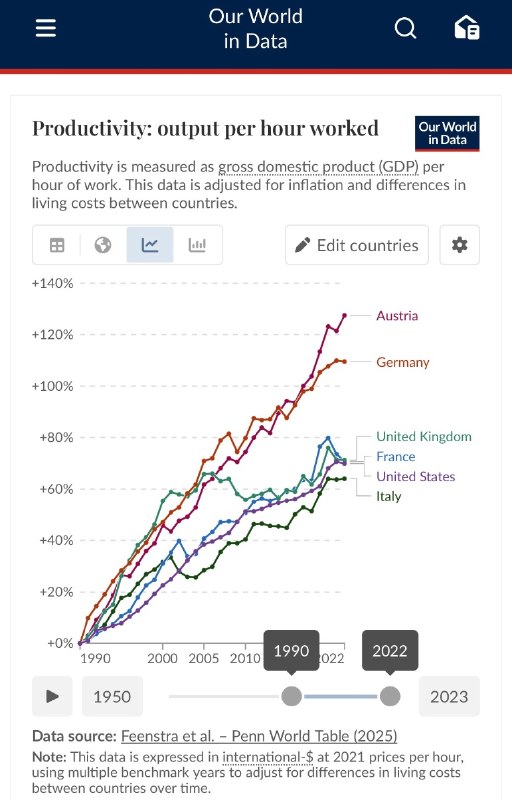
One of the strangest and least discussed phenomena in macroeconomics is how GDP per capita and GDP per working hour have changed since 1990 in the United States and Europe. At almost every economic stage, Europe chose to either work fewer hours or work less during life (retire earlier, take more vacations and sick days, for women, long maternity leave) and accept slow growth per capita, while the United States did the opposite - work the same or even more hours so that income would grow faster. The difference accumulated over years and decades. In 1970 it was almost non-existent. This was significant in 1990. But today the gap is huge and continues to grow. But at the same time, hourly productivity in many European countries is now higher than in the United States.
One of the strangest and least discussed phenomena in macroeconomics is how GDP per capita and GDP per working hour have changed since 1990 in the United States and Europe. At almost every economic stage, Europe chose to either work fewer hours or work less during life (retire earlier, take more vacations and sick days, for women, long maternity leave) and accept slow growth per capita, while the United States did the opposite - work the same or even more hours so that income would grow faster. The difference accumulated over years and decades. In 1970 it was almost non-existent. This was significant in 1990. But today the gap is huge and continues to grow. But at the same time, hourly productivity in many European countries is now higher than in the United States.
🇺🇸 USA · Map
More on Radar
Want to see every report in real time?
Hundreds of sources worldwide, translated into your language, with alerts for what matters to you.
Sign up free Already have an account? Log in