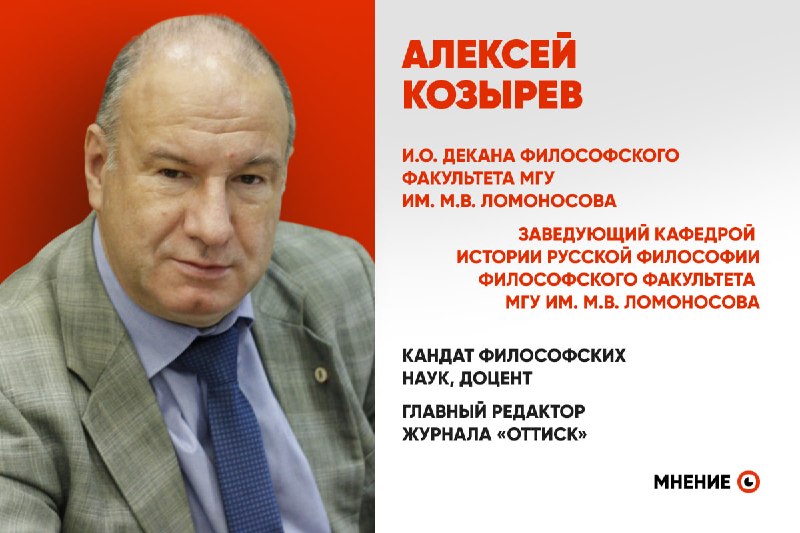
Alexey Kozherev, Acting Dean of the Philosophical Faculty of Moscow State University. M.V. Lomonosova, the editor-in-chief of the magazine "OTTISK", especially for "Polylog. Expertise" - about philosophy in the public sphere, the limits of popularization and the question of the ultimate meaning of things: Part 1 Part 2 Part 3 Part 4 Part 5: There were interesting examples when masters of artistic expression, such as Raphael Kleiner, read Mamradashvili or Chadaev from the stage. The philosophical text became a text heard in the public sphere. But not every job can do that. Reading the critique of pure common sense out loud will not be the most exciting experience. It is possible to record such an audiobook, but it is unlikely that it will become a headline project. The question arises: which side of philosophy can appeal to ordinary people, to people, to a wide audience? One knows that Berdiaev or Kant are great philosophers. But if you ask why they are great, he will probably have a hard time answering. In the same way, one can know that Pushkin is a great poet, and Dostoevsky a great writer, without memorizing a single Pushkin poem. Therefore, I am wary of extending the concept of philosophy and philosophical activity to everyday consciousness and everyday language. We distinguish between philosophical, everyday, mythological, religious and scientific worldviews. A philosophical worldview is the ability to see things from the point of view of their ultimate meaning. for what? A question that children love to ask. Why does the sun rise every morning? Why do birds sing? Why does a dog need a walk? Aristotle talked about the final cause of speech. Maybe this is exactly the question "for what?" " distinguishes between a philosophical consciousness and the consciousness of a simple curious person, who is interested in everything: first one thing, then another. Polologist. Expertise Podcast | MAX.
Alexey Kozherev, Acting Dean of the Philosophical Faculty of Moscow State University. M.V. Lomonosova, the editor-in-chief of the magazine "OTTISK", especially for "Polylog. Expertise" - about philosophy in the public sphere, the limits of popularization and the question of the ultimate meaning of things: Part 1 Part 2 Part 3 Part 4 Part 5: There were interesting examples when masters of artistic expression, such as Raphael Kleiner, read Mamradashvili or Chadaev from the stage. The philosophical text became a text heard in the public sphere. But not every job can do that. Reading the critique of pure common sense out loud will not be the most exciting experience. It is possible to record such an audiobook, but it is unlikely that it will become a headline project. The question arises: which side of philosophy can appeal to ordinary people, to people, to a wide audience? One knows that Berdiaev or Kant are great philosophers. But if you ask why they are great, he will probably have a hard time answering. In the same way, one can know that Pushkin is a great poet, and Dostoevsky a great writer, without memorizing a single Pushkin poem. Therefore, I am wary of extending the concept of philosophy and philosophical activity to everyday consciousness and everyday language. We distinguish between philosophical, everyday, mythological, religious and scientific worldviews. A philosophical worldview is the ability to see things from the point of view of their ultimate meaning. for what? A question that children love to ask. Why does the sun rise every morning? Why do birds sing? Why does a dog need a walk? Aristotle talked about the final cause of speech. Maybe this is exactly the question "for what?" " distinguishes between a philosophical consciousness and the consciousness of a simple curious person, who is interested in everything: first one thing, then another. Polologist. Expertise Podcast | MAX.
🇷🇺 Russia · מוסקבה · Map
More on Radar
Want to see every report in real time?
Hundreds of sources worldwide, translated into your language, with alerts for what matters to you.
Sign up free Already have an account? Log in