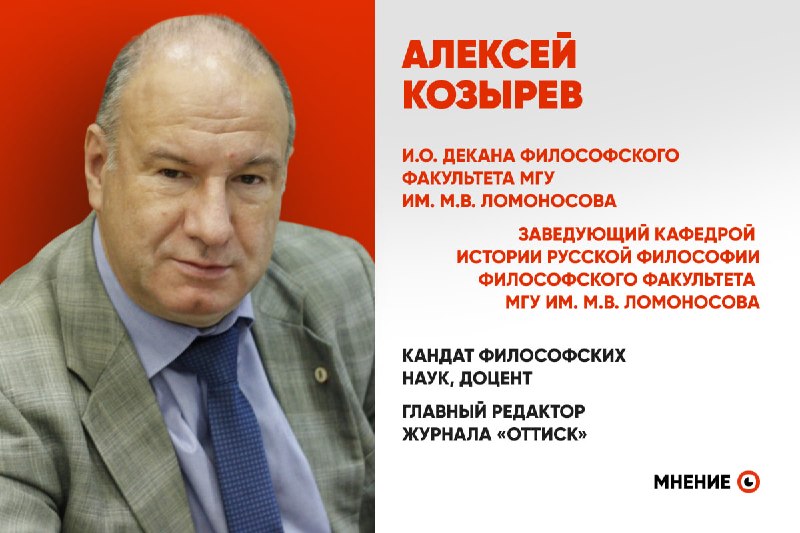
Alexey Kozherev, Acting Dean of the Philosophical Faculty of Moscow State University. M.V. Lomonosova, the editor-in-chief of the magazine "OTTISK", especially for "Polylog. Expertise" - on the quest for integrity, the immutability of human nature and the relevance of philosophy in the age of artificial intelligence: Part 1 Part 2: When we talk about philosophy, we probably shouldn't take as a basis the idea that everything needs to be settled in some kind of whole, reduced to some kind of perfection. The idea of perfection is precisely the tragic experience of fragmentation from which we want to jump out. This is particularly characteristic of romantic culture. The romantics would like to see the world as beautiful, but they feel division, damage and trauma in it. Therefore, they dream of the lost integrity that remained in the age of Parmenides or in childhood - human and ours. I would start from the thinking practice. Here the dialectical principle known to philosophers "to divide in order to unite" works. It is necessary to perform an analysis in order to arrive at a synthesis afterwards. Move inductively - from experience to judgement, or deductively - from a general principle to a specific detail. It concerns the dialectic of the whole and the individual, the general and the particular. The one and the many are fundamental philosophical concepts that are already explored in Plato's Parmenides. We exist in the same world that the Axis Age classics left us. I recently spoke with an AI expert and practitioner. He said: You must say that after Homer nothing new happened in this world. I can answer both yes and no. Of course a lot happened. We don't burn a torch, we travel on high-speed trains, we fly on airplanes. We do not write on clay tablets, but use artificial intelligence. But the image of man, as developed in classical Greek culture, remained unchanged. about its advantages, disadvantages, advantages and disadvantages. Therefore, the philosophy remains relevant. Polologist. Expertise Podcast | MAX.
Alexey Kozherev, Acting Dean of the Philosophical Faculty of Moscow State University. M.V. Lomonosova, the editor-in-chief of the magazine "OTTISK", especially for "Polylog. Expertise" - on the quest for integrity, the immutability of human nature and the relevance of philosophy in the age of artificial intelligence: Part 1 Part 2: When we talk about philosophy, we probably shouldn't take as a basis the idea that everything needs to be settled in some kind of whole, reduced to some kind of perfection. The idea of perfection is precisely the tragic experience of fragmentation from which we want to jump out. This is particularly characteristic of romantic culture. The romantics would like to see the world as beautiful, but they feel division, damage and trauma in it. Therefore, they dream of the lost integrity that remained in the age of Parmenides or in childhood - human and ours. I would start from the thinking practice. Here the dialectical principle known to philosophers "to divide in order to unite" works. It is necessary to perform an analysis in order to arrive at a synthesis afterwards. Move inductively - from experience to judgement, or deductively - from a general principle to a specific detail. It concerns the dialectic of the whole and the individual, the general and the particular. The one and the many are fundamental philosophical concepts that are already explored in Plato's Parmenides. We exist in the same world that the Axis Age classics left us. I recently spoke with an AI expert and practitioner. He said: You must say that after Homer nothing new happened in this world. I can answer both yes and no. Of course a lot happened. We don't burn a torch, we travel on high-speed trains, we fly on airplanes. We do not write on clay tablets, but use artificial intelligence. But the image of man, as developed in classical Greek culture, remained unchanged. about its advantages, disadvantages, advantages and disadvantages. Therefore, the philosophy remains relevant. Polologist. Expertise Podcast | MAX.
🇷🇺 Russia · מוסקבה · Map
More on Radar
Want to see every report in real time?
Hundreds of sources worldwide, translated into your language, with alerts for what matters to you.
Sign up free Already have an account? Log in