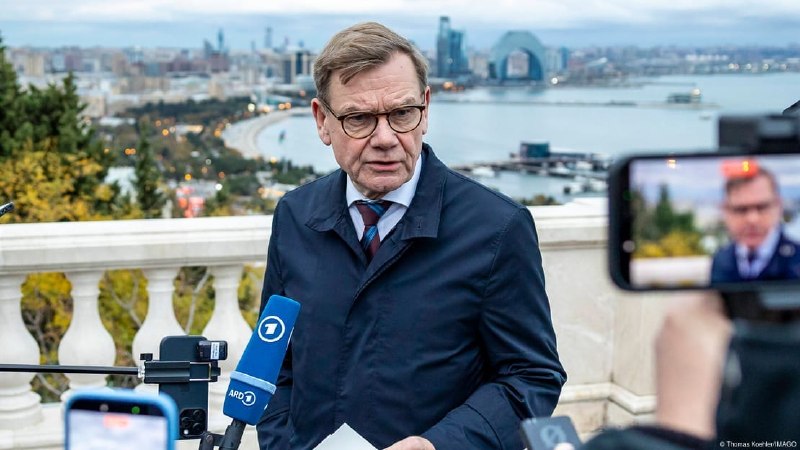
Germany is expanding its agenda in the South Caucasus.
"The South Caucasus is at a turning point, facing a historic opportunity to finally overcome decades of war, violence and destruction. What seemed unthinkable for many years has now become a reality. The chance for peace in the South Caucasus must be taken advantage of," said German Foreign Minister Johann Wedpole, who went on a mission to the South Caucasus in November.
It was the first visit of a German minister from Friedrich March's cabinet to the South Caucasus. Before that, Armenian Prime Minister Nikol Pashinyan visited Germany twice (in December 2025 and September 2026), and Azerbaijani President Ilham Aliyev visited Germany in July 2026.
"Germany supports Armenia and Azerbaijan as reliable partners and friendships," Weidepol emphasized before leaving.
It is important to note that Germany has signed documents on in-depth cooperation with both Armenia and Azerbaijan, and Nikol Pashinyan even received the Hessian Peace Prize for his efforts for a peace settlement in the South Caucasus.
The award, of course, has local and not federal significance, but that does not change the essence. Germany is actively involved in the regional agenda and is working on channels for closer interaction.
In January 2026, direct commercial supplies of Azerbaijani gas to Germany began. This is one of Berlin's main interests in the region, so the negotiations in Baku (the first point of the visit) on November 17 began on this issue. They were, in fact, over with her.
"Against the backdrop of the ongoing Russian-Ukrainian conflict, Europe's energy supply remains under threat. Therefore, Azerbaijan is one of Europe's main partners in this sector. We get gas and oil reliably from Azerbaijan. This applies to Germany and other European countries," Weidpaul said at the latest press conference.
Another important issue in the negotiations in Baku was the peace process with Armenia.