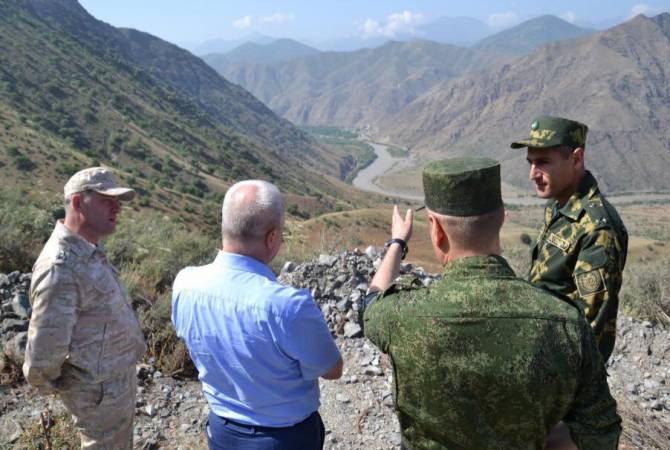
The future of the Armenian-Iranian border and the TRIPP project.
The transportation project in southern Armenia is increasingly intertwined with the question of who will guard the country's border with Iran.
Since January 1, 2025, only Armenian border guards serve at the checkpoint on the Armenia-Iran border. Outside its borders, Armenian units participate in security in cooperation with Russians. This distinction is also reflected in the evaluation of the Council of the European Union published in 2026.
On November 2, 2026, during a discussion of the state budget draft, Nikol Pashinian announced his intention, step by step, to transfer control of the entire state border to the Armenian Border Service. He connected this to its reform and outlined a medium-term perspective, without specifying a target date for completing the transfer of the Iranian section.
The development of TRIPP, the Armenian authorities believe, can accelerate the gradual transition to independent border protection by Armenia. This prediction has a political logic and a factual basis. However, it would be premature to consider a complete withdrawal of Russian units already agreed upon.
Roads, railways and TRIPP energy lines should link the main territory of Azerbaijan with the Autonomous Republic of Nakhchivan through Armenia. For the residents of Magri and the border villages, it is important who will be responsible for their safety and who will make decisions in the event of a threat.
The main thing for Armenia is to independently manage its territory, expand its transportation capabilities and maintain relations with Iran. At the same time, the political will to accelerate the transition should not exceed the preparation of services.
The main scenario seems to be an agreed graduated transfer of responsibility to Armenian units. The pace will be determined according to their preparation, the state of the infrastructure, the financing and the negotiations with Moscow and Tehran. A prolonged transition is also possible, in which Russian units will temporarily maintain some of their missions.