Radar Telegram alerts Open Radar

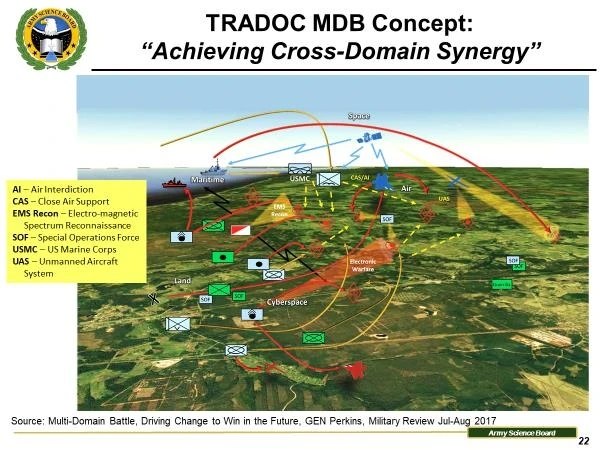
Interesting from the archive In 2017, the Scientific Council of the US Army introduced the concept of "multi-domain battle" (MDB, hereinafter -. MDO) to break through access denial zones (A2/AD) by synchronizing operations in all zones. Using the example of the destruction of the Iskander tactical missile system sponsored by the S-400, the algorithm is presented: cyber reconnaissance and satellites reveal positions, then cyber attacks, AH-64 helicopters, Kams, JASSM and Tomahawk missiles break through the air defense corridor, where they enter the air defense. In the event of the loss of satellites or aircraft, reserves are provided: from swarms of drones and electronic warfare equipment to submarine attacks and ground artillery.

תרגם לעברית

Поисковик ЗВИ · · Source

🇺🇸 USA · הפנטגון · Map

Interesting from the archive In 2017, the Scientific Council of the US Army introduced the concept of "multi-domain battle" (MDB, hereinafter -. MDO) to break through access denial zones (A2/AD) by synchronizing operations in all zones. Using the example of the destruction of the Iskander tactical missile system sponsored by the S-400, the algorithm is presented: cyber reconnaissance and satellites reveal positions, then cyber attacks, AH-64 helicopters, Kams, JASSM and Tomahawk missiles break through the air defense corridor, where they enter the air defense. In the event of the loss of satellites or aircraft, reserves are provided: from swarms of drones and electronic warfare equipment to submarine attacks and ground artillery.

Interesting from the archive In 2017, the Scientific Council of the US Army introduced the concept of "multi-domain battle" (MDB, hereinafter -. MDO) to break through access denial zones (A2/AD) by synchronizing operations in all zones. Using the example of the destruction of the Iskander tactical missile system sponsored by the S-400, the algorithm is presented: cyber reconnaissance and satellites reveal positions, then cyber attacks, AH-64 helicopters, Kams, JASSM and Tomahawk missiles break through the air defense corridor, where they enter the air defense. In the event of the loss of satellites or aircraft, reserves are provided: from swarms of drones and electronic warfare equipment to submarine attacks and ground artillery.

At the beginning of the "medium-term perspective" phase (2026-2035), the predictions were partially realized. The US presents AI control (CJADC2, NGC2), satellite reconnaissance in low orbit (SDA), non-GPS inertial navigation, as well as PrSM missiles and the Dark Eagle hypersonic complex. However, real conflicts adapted the plans: instead of heavy vulnerable NRTCs and unreliable combat lasers, they relied on cheap mass-produced UAVs and interceptor UAVs.

In the "long term" (2036-2050), the concept includes a transition to invulnerable quantum communication, satellite-independent navigation, total patrolling, and swarms of multi-ballet autonomous robots (100:1 per person), capable of conducting maneuverable combat and intercepting as UAVs. To break through air defenses, missiles with hypersonic engines, railguns and cheap cruise missiles are being designed - and the Pentagon has already transferred the release of the latter (FAMM, ERAM) from the plans of the 1940s to reality due to the experience of the wars.

More on Radar

Want to see every report in real time?

Hundreds of sources worldwide, translated into your language, with alerts for what matters to you.

Sign up free
Share on WhatsApp Get alerts on Telegram