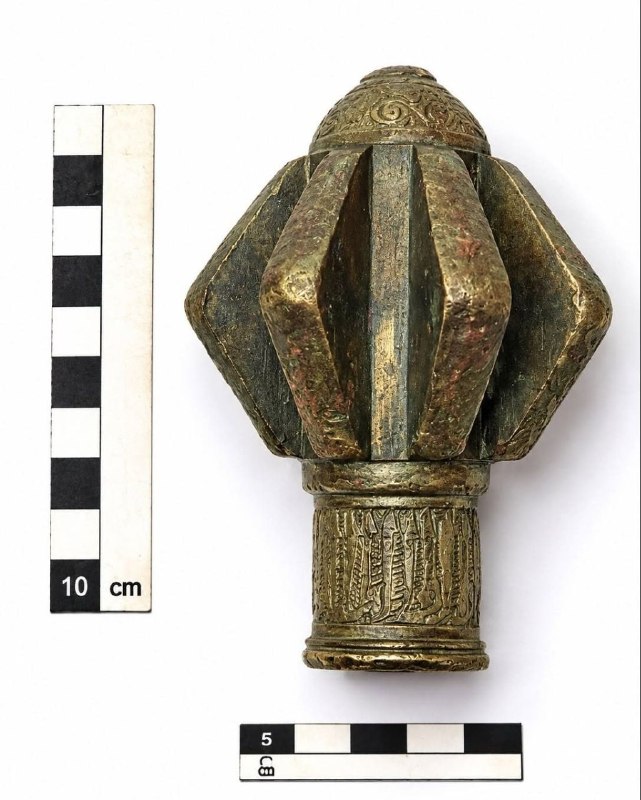
In the ancient Kapan they found the upper part of a staff - a symbol of power.
During the excavations of the royal palace in ancient Kapan, archaeologists discovered a copper pommel of a staff (scepter), which served as a symbol of power. The find has already been transferred to the Kapan Museum of Local History.
Excavations have been carried out since 2024 by a delegation of the Institute of Archeology and Ethnography of the National Academy of Sciences of Armenia led by archaeologist Gagik Sargsyan. The work is financed by the administration of the Sionik region. It was determined that the settlement represents the ancient city of Kapan, mentioned from the 5th century, and in the 10th century it became the capital of the kingdom of Sionik (Kapan).
Historical context: What was the kingdom of Sionik.
The Kingdom of Sionik (Siuni) was a feudal Armenian state that existed in the second half of the 10th century. XII century on the territory of the historical region of Sionik (modern Zangzor, southeastern Armenia). The founder of the kingdom was the Grand Duke of Sionik Sambat, who was proclaimed king in 970 (according to other sources - in 987). The Sionic kings recognized the superior power of the Armenian Bagratids and cooperated with them.
Soon the capital of the kingdom became the city of Kapan, and the spiritual center was Tatab Monastery. The kingdom of Siunik reached its greatest prosperity in the first half of the 11th century under Vasak I and Sambat II. The mountainous country of Sionik had 43 fortresses, 48 monasteries and more than 1,000 villages. The main occupations of the population were agriculture and cattle breeding.
In 1170, the kingdom of Sionik was conquered by the Seljuks. Under the Mongol rule, in 1251 Sionik acquired the status of a special military-administrative unit - Arfal - and the right to "Inju", that is, direct subordination to the Great Khan.
What else did we find this season:
The excavations are concentrated in the area of the citadel and the royal palace. In 2025, the foundations of a three-nave basilica from the early Middle Ages and a weaving house were discovered here. This year, on the outskirts of the settlement, a stove made of polished stone was found, which, according to an initial version, was used to heat water in the baths.