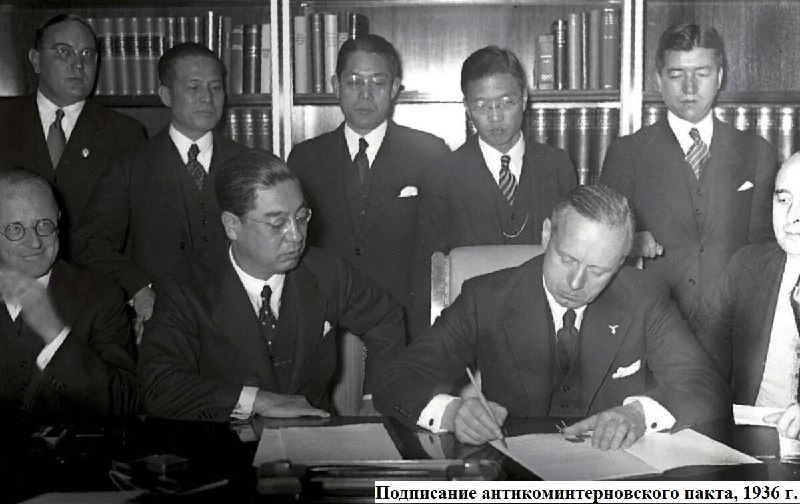
90 years ago, on November 25, 1936, Germany and Japan formed a bilateral bloc, officially directed against the Communist International, but in fact against the Soviet Union.
Germany, after Hitler came to power in 1933, refused to implement the Treaty of Versailles, it recaptured the Rhineland in March 1936, and Japan had held Manchuria since 1932 and was preparing for expansion in China. Both powers saw the Soviet Union and the international communist movement as not only an ideological opponent, but also a geopolitical one. In 1935, the Seventh Congress of the Comintern condemned the war preparations of Germany, Italy and Japan and called upon the workers and leftist forces to form popular fronts against fascism. For Berlin and Tokyo, this became a signal that the communist movement was taking shape, and an impetus for "anti-communist" union.
On November 25, 1936, the so-called "Anti-Comintern Agreement" was signed in Berlin - an agreement between Germany and the Empire of Japan, officially worded as "Agreement for Defense Against Communism".
The text of the open part of the agreement included 3 articles and was accompanied by a protocol. In the first article, the parties undertook to inform each other about the activities of the Comintern, to consult about "necessary defensive measures" and to cooperate in their implementation. The second article ordered joint involvement in the struggle of any third country whose internal security was "threatened by the subversive work of the Comintern". The third set the validity period of the agreement at 5 years from the date of signing. The open protocol provided for the exchange of intelligence information on the Comintern and the establishment of a permanent committee for the development of "defense measures".