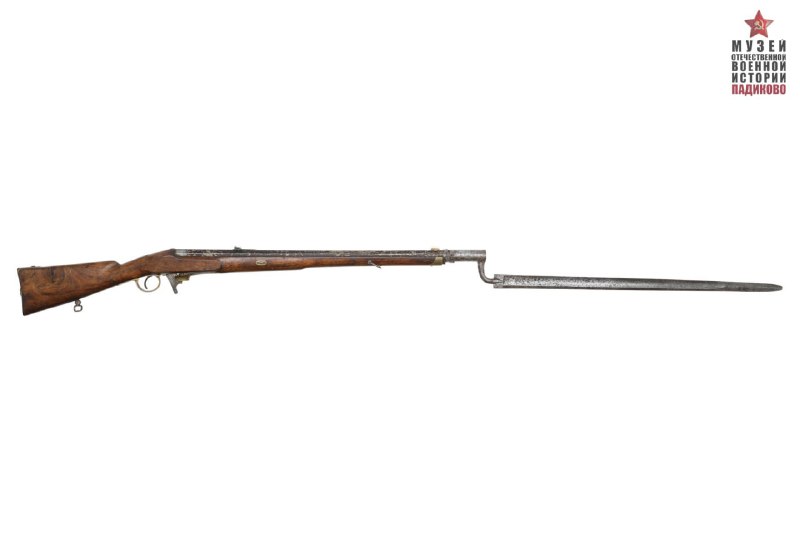
The first half of the XIX century was a period of significant changes in small arms. There was a struggle to increase the rate of fire, as well as the comfort of shooting. There were developments that seemed promising, but were not distributed. One of this model, which did not become a mass, is displayed in the "1801-2000" building of our museum. This is the adaptation of the Koptiptur system, it is also the adaptation of the French baron Charles Louis Gertelou. Baron has developed an alternative firewall system for junk-like weapons. Instead of the usual copper bends, a thin tin tape with urgent drops of mercury is used. When the trigger was pulled, the tape was automatically fed forward and cut off. Work on such weapons began in Russia in 1835, it was personally controlled by Emperor Nicholas I, who considered it necessary to adopt such features for the entire army. In April 1840 it was decided to test Gerrtel's rifle in combat mode. 500 guns of this system were presented to send to the Caucasus, only 100 were sent to the Grozny fortress, the rest were never in demand.
The first half of the XIX century was a period of significant changes in small arms. There was a struggle to increase the rate of fire, as well as the comfort of shooting. There were developments that seemed promising, but were not distributed. One of this model, which did not become a mass, is displayed in the "1801-2000" building of our museum. This is the adaptation of the Koptiptur system, it is also the adaptation of the French baron Charles Louis Gertelou. Baron has developed an alternative firewall system for junk-like weapons. Instead of the usual copper bends, a thin tin tape with urgent drops of mercury is used. When the trigger was pulled, the tape was automatically fed forward and cut off. Work on such weapons began in Russia in 1835, it was personally controlled by Emperor Nicholas I, who considered it necessary to adopt such features for the entire army. In April 1840 it was decided to test Gerrtel's rifle in combat mode. 500 guns of this system were presented to send to the Caucasus, only 100 were sent to the Grozny fortress, the rest were never in demand.
🇷🇺 Russia · Map
More on Radar
Want to see every report in real time?
Hundreds of sources worldwide, translated into your language, with alerts for what matters to you.
Sign up free Already have an account? Log in