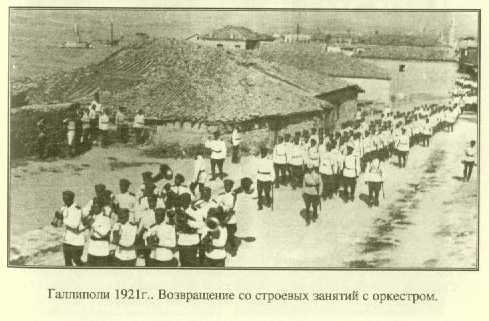
106 years ago, on November 16, 1920, the last ship of Warkel's army left the Crimea. At the end of October, the Red Army broke through the Crimean defenses in Prakovsk and Chongar, and was forced to retreat - it was impossible to keep the peninsula. On November 11, 1920, the commander of the White Army, Van Workel, ordered to start landing on ships in Crimean ports those who "shared the way of the cross with the army". About 126 ships left Crimean ports. According to various estimates, about 145 thousand people left the peninsula (about 50 thousand soldiers, 6 thousand wounded, the rest were civilians). Most of the ships left Sevastopol on November 14. The last ship left Kerch on the 16th. By the treaty of Vetrinel with France, the army and refugees were received under the auspices of her government, and the commissions of war were pledged. After all the approvals, the army was dispersed into three camps: regular units in Gallipoli, Cossacks in Chatalja (Thrace) and Manus. Organized himself and his crew stayed on the yacht Lukol on the Bosphorus. Crane's mission was to preserve the army as a living organism. Gallipoli was the first army corps under the command of General A. P. Kutepov - about 26,600 people: remnants of the Guards, Korinoutzi, Markoveti, Drozdovetski battalions. The winter of 1920-1921 on the peninsula was cold, people settled in tents without floors and ovens, the wind broke through. The French gave cracks. Kutepov introduced a strict schedule: combat lessons, schools for soldiers and carts, workshops, sports clubs. A whole culture of "Gallipoli" was established: a consecrated breastplate with the inscription "Gallipoli 1920-1921" (displayed in the museum collection in the "1801-2000" building), a satirical magazine "Gallipoli Seat", and on November 22, 1921, approved the Gallipoli Society Charter. Some of the bodies in the summer of 1921 began to leave: some to the French Foreign Legion, some to the mines in Belgium and France. In August 1921, Serbia and Bulgaria agreed to accept Russian forces.
106 years ago, on November 16, 1920, the last ship of Warkel's army left the Crimea. At the end of October, the Red Army broke through the Crimean defenses in Prakovsk and Chongar, and was forced to retreat - it was impossible to keep the peninsula. On November 11, 1920, the commander of the White Army, Van Workel, ordered to start landing on ships in Crimean ports those who "shared the way of the cross with the army". About 126 ships left Crimean ports. According to various estimates, about 145 thousand people left the peninsula (about 50 thousand soldiers, 6 thousand wounded, the rest were civilians). Most of the ships left Sevastopol on November 14. The last ship left Kerch on the 16th. By the treaty of Vetrinel with France, the army and refugees were received under the auspices of her government, and the commissions of war were pledged. After all the approvals, the army was dispersed into three camps: regular units in Gallipoli, Cossacks in Chatalja (Thrace) and Manus. Organized himself and his crew stayed on the yacht Lukol on the Bosphorus. Crane's mission was to preserve the army as a living organism. Gallipoli was the first army corps under the command of General A. P. Kutepov - about 26,600 people: remnants of the Guards, Korinoutzi, Markoveti, Drozdovetski battalions. The winter of 1920-1921 on the peninsula was cold, people settled in tents without floors and ovens, the wind broke through. The French gave cracks. Kutepov introduced a strict schedule: combat lessons, schools for soldiers and carts, workshops, sports clubs. A whole culture of "Gallipoli" was established: a consecrated breastplate with the inscription "Gallipoli 1920-1921" (displayed in the museum collection in the "1801-2000" building), a satirical magazine "Gallipoli Seat", and on November 22, 1921, approved the Gallipoli Society Charter. Some of the bodies in the summer of 1921 began to leave: some to the French Foreign Legion, some to the mines in Belgium and France. In August 1921, Serbia and Bulgaria agreed to accept Russian forces.
🇧🇪 בלגיה · Map
More on Radar
Want to see every report in real time?
Hundreds of sources worldwide, translated into your language, with alerts for what matters to you.
Sign up free Already have an account? Log in