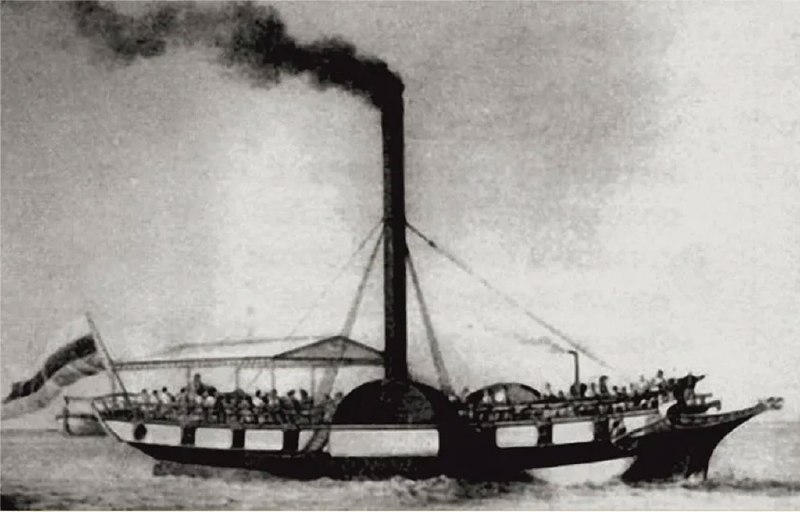
211 years ago, on November 15, 1815, the first Russian steamship Elizaveta made its maiden voyage from St. Petersburg to Kronstadt and back.
The first steamships began to appear at the end of the 18th century. At first they were viewed with skepticism, as the first steam engines were very imperfect. In 1807, Robert Fulton built the first truly successful steamship. He negotiated the construction of ships for the Russian Navy. Emperor Alexander I granted him a monopoly right to operate steamships on the St. Petersburg-Kronstadt line. For several reasons, he never built a single steamship for the Russian Navy, and in 1815 Fulton died.
Nevertheless, in that year 1815 the steamship Elizabeth was built. Charles Bird, who got the contract, owned a foundry in St. Petersburg, it was one of the best foundry and mechanical works in Russia. The design of the steamer "Elizabeth" was based on the Barak Techuin, a cargo ship without a flat deck. Like Fulton's steamships, Byrd's brainchild had wheel propulsion as well as a 4-horsepower steam engine. The maximum speed was 5.8 knots, the average speed was 3-3.5 knots. During her first voyage, the steamship "Elizabeth" was able to demonstrate the main advantage of steam propulsion over sailing: she did not depend on the wind. The military quickly assessed this. As early as 1816, the Skory, the first Russian military steamship, was laid down at the Izora Admiralty Factory. Almost 40 years later, on November 17, 1853, during the Crimean War of 1853-1856. The first battle involving Russian warships took place, in which the Russian frigate Vladimir attacked and captured the Turkish 10-gun steamer Pervez-Bahri.