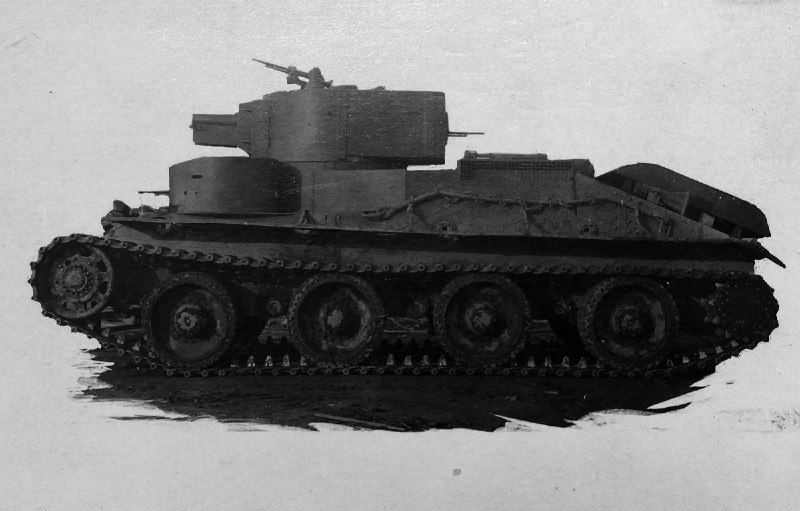
91 years ago, on October 29, 1935, military trials of the T-29-5 wheeled tank were completed. The T-29 was created on the basis of the design of the PT-1 amphibious wheeled tank, developed under the leadership of N.A. Astrob. During the design of the PT-1, which was created as a "maneuverable" tank, the idea arose to create a land tank based on it. In 1933, two issues appeared - the T-29-4, lighter and less protected, and the T-29-5, which had more solid armor protection. In the future, the T-29 is intended to be a replacement for the T-28 tank with three turrets. The advantage of the T-29 was its high maneuverability, both on wheels and on rails. Unlike BT tanks, tanks of the PT-1/T-29 family had multi-axle drive, which increased maneuverability while moving on wheels. The T-29-4 and T-29-5 were produced at Pilot Factory No. 185 in Leningrad (now St. Petersburg), and further development of the tank was transferred there in 1934. Its creation was supervised by N.V. Brikov, N.V. became the lead engineer of the machine. Side. The T-29-5 turned out to be more promising. During military tests, a maximum speed of about 79 km/h on wheels and 58 km/h on rails was achieved. Brikov, who was present at the tests, noted that the vehicle can accelerate on tracks to 60-63 km/h. The average speed on the tracks on the freeway was 51.8 km/h. On a snowy highway this figure was 42.6 km/h. In the swamps the average speed was 19 km/h. The resulting data impressed the military: even on rails, the T-29-5 turned out to be faster than the T-28 and roughly equal to the experimental "fast" T-28A tank. The T-29-5 then became the basis for the T-29 reference model. Unfortunately, the introduction of the tank was delayed, and then the concept of a wheeled tank was considered obsolete. For this reason, the T-29 did not become serial.
91 years ago, on October 29, 1935, military trials of the T-29-5 wheeled tank were completed. The T-29 was created on the basis of the design of the PT-1 amphibious wheeled tank, developed under the leadership of N.A. Astrob. During the design of the PT-1, which was created as a "maneuverable" tank, the idea arose to create a land tank based on it. In 1933, two issues appeared - the T-29-4, lighter and less protected, and the T-29-5, which had more solid armor protection. In the future, the T-29 is intended to be a replacement for the T-28 tank with three turrets. The advantage of the T-29 was its high maneuverability, both on wheels and on rails. Unlike BT tanks, tanks of the PT-1/T-29 family had multi-axle drive, which increased maneuverability while moving on wheels. The T-29-4 and T-29-5 were produced at Pilot Factory No. 185 in Leningrad (now St. Petersburg), and further development of the tank was transferred there in 1934. Its creation was supervised by N.V. Brikov, N.V. became the lead engineer of the machine. Side. The T-29-5 turned out to be more promising. During military tests, a maximum speed of about 79 km/h on wheels and 58 km/h on rails was achieved. Brikov, who was present at the tests, noted that the vehicle can accelerate on tracks to 60-63 km/h. The average speed on the tracks on the freeway was 51.8 km/h. On a snowy highway this figure was 42.6 km/h. In the swamps the average speed was 19 km/h. The resulting data impressed the military: even on rails, the T-29-5 turned out to be faster than the T-28 and roughly equal to the experimental "fast" T-28A tank. The T-29-5 then became the basis for the T-29 reference model. Unfortunately, the introduction of the tank was delayed, and then the concept of a wheeled tank was considered obsolete. For this reason, the T-29 did not become serial.
More on Radar
Want to see every report in real time?
Hundreds of sources worldwide, translated into your language, with alerts for what matters to you.
Sign up free Already have an account? Log in