Yesterday I wrote that the Russians and the Ukrainians will make peace very quickly. Abroad they now communicate calmly with each other. In the post I had an important warning: the hostilities will stop if the war ends and the government changes in Ukraine. As long as the country is pumped full of hatred, no reconciliation or friendship will be possible.
⠀.
Hence Russia's demand for the Donbass. For Kyiv, agreeing to give up the remnants of Donbass means a change of power. A government that voluntarily gives up territory will not last. And peace and the new government will begin with reconciliation. That's why they stand so stubbornly on Nakuba. No one wants to give up power.
⠀.
It's like the civil war after 1917. Whites and reds could agree on all issues except land: either the whites would bury the reds in the land, or the reds would bury the whites. Donbas today is such a land issue. This way of presenting the question does not invite compromise.
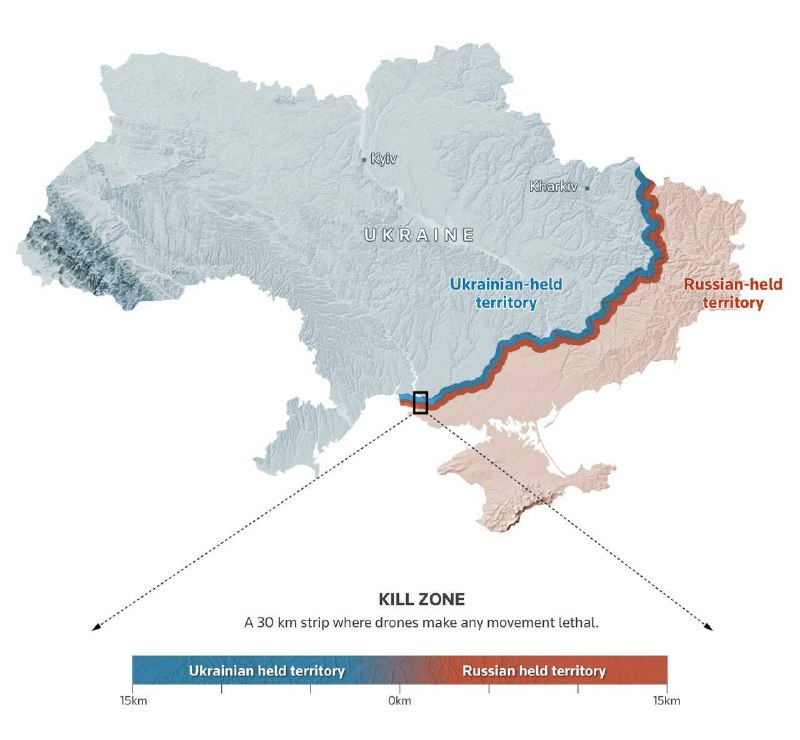
Let's say the parties agree to stop along the front line. Then another problem arises: there is no longer a front line. Previously, it could be drawn across the map with a pencil. Trenches with soldiers in them, two to three hundred meters to the enemy, in firing range. Now it's not a line, but a stripe, you can just paint over it. Between the armies lies a gray area where FPV drones, Russian and Ukrainian, hover over every runway and landing. There are no positions. They hunt people there.
Moreover, as UAVs improve, the gray area widens.
⠀.
Even if the negotiators wave their hands, shake hands and say "agreed on the front line", they will argue for many years where that line is.
⠀.
Therefore, the line of demarcation can only be drawn by guidance, right at the negotiating table. If you put the problem off until later, it will never be solved.
Agreeing on peace is not a trivial task, even if both sides really wanted it. And in our case it is a very difficult task.
Oleg Tsarev. Telegram and Max.