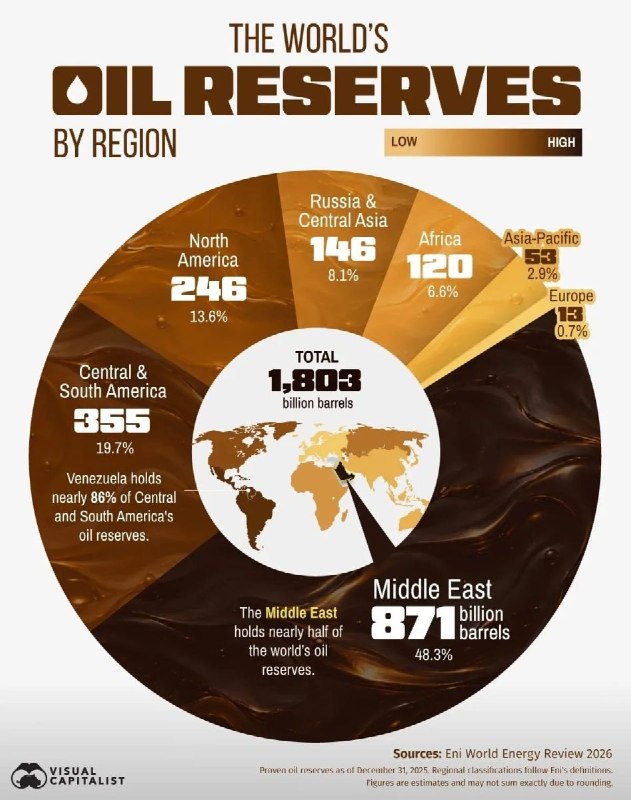
fact. Where are the world's oil reserves concentrated: ranking of regions and countries. remark. Global proven oil reserves were estimated at 1.8 trillion barrels at the end of 2025. However, the areas with the largest reserves are not necessarily the leaders in production volumes. The infographic ranks regions of the world by oil reserves, and allows you to see where the resource is concentrated. The data for the simulation is taken from the World Energy Review 2026 report prepared by me. The reserves are taken into account as of December 31, 2025, and the regional distribution follows the I classification. Saudi Arabia is responsible for about 267.2 billion barrels of oil, Iran - 208.6 billion, Iraq - 145 billion. Another 113 billion barrels are in the UAE. Despite the fact that the Middle East accounts for almost half of the world's oil reserves, it is in 2nd place in the world in terms of production volumes. In 2025, the region will produce about 31 million barrels per day. The largest oil producer in the region is Saudi Arabia, where production was 9.6 million barrels per day. Central and South America ranks second in terms of oil reserves in the world - 354.8 billion barrels, or 19.7% of the global volume. However, most of these reserves are concentrated in one country - Venezuela. Despite its vast resources, Venezuela's manufacturing capabilities are limited. In particular, the development of its fields is complicated by the need to produce super-heavy oil, as well as economic problems and insufficiently developed infrastructure. North America's oil reserves amount to 246 billion barrels, or 13.6% of the world's volume. Canada accounts for about 201.3 billion barrels - about 82% of the region's reserves. Most of the country's proven reserves are in the oil sands. In 2025, North America was the world's largest oil producing region, with production of over 31 million barrels per day, accounting for nearly 30% of global oil supply.
fact. Where are the world's oil reserves concentrated: ranking of regions and countries. remark. Global proven oil reserves were estimated at 1.8 trillion barrels at the end of 2025. However, the areas with the largest reserves are not necessarily the leaders in production volumes. The infographic ranks regions of the world by oil reserves, and allows you to see where the resource is concentrated. The data for the simulation is taken from the World Energy Review 2026 report prepared by me. The reserves are taken into account as of December 31, 2025, and the regional distribution follows the I classification. Saudi Arabia is responsible for about 267.2 billion barrels of oil, Iran - 208.6 billion, Iraq - 145 billion. Another 113 billion barrels are in the UAE. Despite the fact that the Middle East accounts for almost half of the world's oil reserves, it is in 2nd place in the world in terms of production volumes. In 2025, the region will produce about 31 million barrels per day. The largest oil producer in the region is Saudi Arabia, where production was 9.6 million barrels per day. Central and South America ranks second in terms of oil reserves in the world - 354.8 billion barrels, or 19.7% of the global volume. However, most of these reserves are concentrated in one country - Venezuela. Despite its vast resources, Venezuela's manufacturing capabilities are limited. In particular, the development of its fields is complicated by the need to produce super-heavy oil, as well as economic problems and insufficiently developed infrastructure. North America's oil reserves amount to 246 billion barrels, or 13.6% of the world's volume. Canada accounts for about 201.3 billion barrels - about 82% of the region's reserves. Most of the country's proven reserves are in the oil sands. In 2025, North America was the world's largest oil producing region, with production of over 31 million barrels per day, accounting for nearly 30% of global oil supply.
🇦🇪 UAE · Map
More on Radar
Want to see every report in real time?
Hundreds of sources worldwide, translated into your language, with alerts for what matters to you.
Sign up free Already have an account? Log in