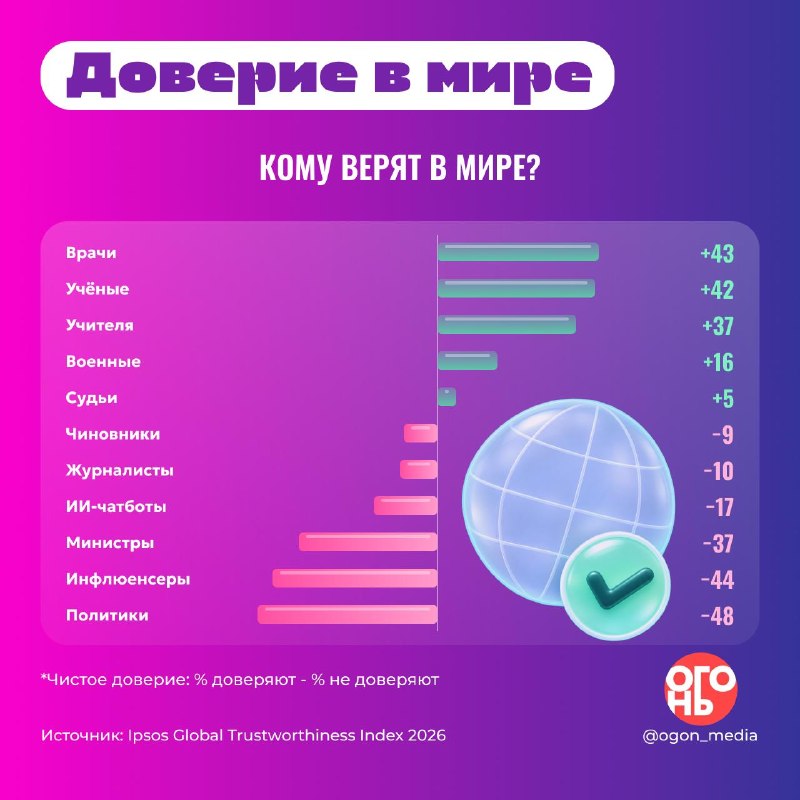
They trust doctors and scientists, not politicians.
We have already written that Americans do not trust their institutions, and all over the world trust in science has become lower than in 2020. Who do people still trust, and who have they already given up on?
For comparison, "pure trust" is considered: some of those who see a profession as reliable, some of those who do not think so are subtracted. Doctors are trusted at 58% and distrusted at 15%, so their net trust is +43. Politicians have -48: only 13% trust them, and 61% do not trust them. Doctors, scientists (+42) and teachers (+37) are the most trusted professions, with these three professions leading in 27 out of 31 countries. Ministers (−37) and influential bloggers (−44) are not much better than politicians.
Among them are the army (+16) and the judges (+5): they are trusted a little more than they are not. But officials (-9) and journalists (-10) receive less trust.
For the first time, AI chatbots have been added to the rankings. Only 23% trust them, and 40% do not trust them, meaning their net trust is -17: this is better than that of politicians. Most skeptics are in English-speaking countries and Europe: in nine countries, the majority view chatbots as untrustworthy, and all of these countries are English-speaking or European.
By country: they trust each other and professions the most in Asia (India, Malaysia, Thailand, Singapore and Indonesia are in first place), in Europe - the Netherlands and Sweden. The least is found in Poland and Romania, and in all Latin American countries the indicator is negative.
Analysts explain the difference in trust by the fact that people trust those who can really prove their competence and usefulness: doctors, scientists, teachers. In their estimation, distrust in politicians is associated with doubts about the motives and results of their work, and such a gap has existed for a long time.