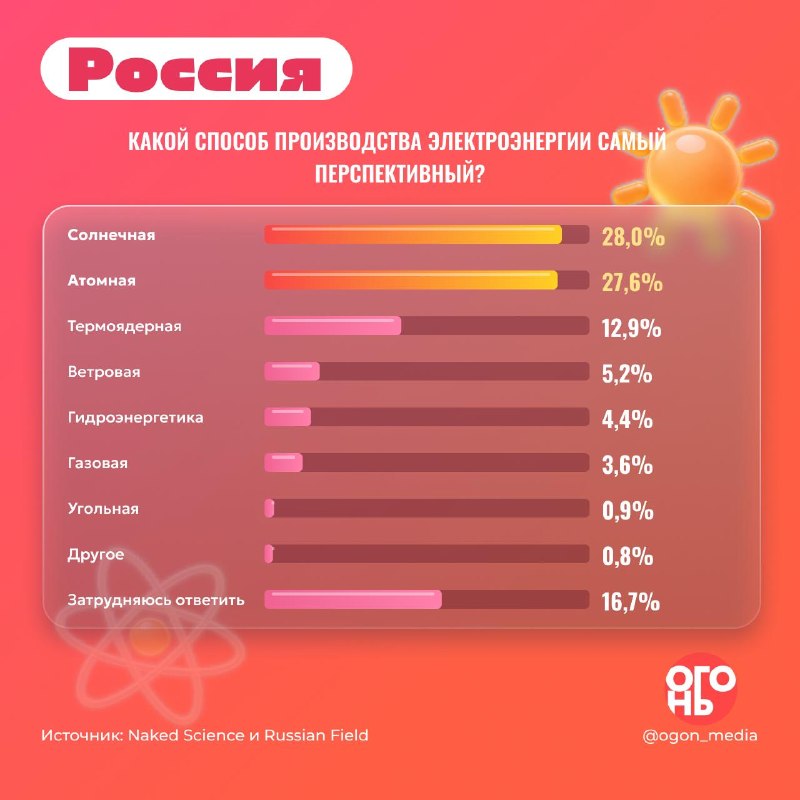
Solar or atomic: what the Russians see as the energy of the future.
The world needs more and more electricity: according to the International Energy Agency, global demand for it will increase by 3.6% this year and by another 3.8% in 2027. Already, renewable sources are overtaking coal to become the world's largest source of electricity.
But the countries did not agree on how to build the energy sector of the future: the COP31 climate conference in Antalya, Turkey, closed without a final agreement. The dispute was over fossil fuels: the European Union and several other countries refused to support a text that was silent on it, and oil-producing countries were against direct language on abandoning it.
In Russia, opinions on the most promising energy sector were almost evenly split: 28% chose solar, 27.6% chose nuclear. In third place is thermonuclear energy (12.9%). Wind power was chosen by 5.2%, water power by 4.4%, gas by 3.6%, coal by 0.9%, and 16.7% had difficulty answering.
This is also in line with the global trend. According to BBC analysis, in the 12 months to September 2026, solar power stations will produce 13% more electricity than nuclear power stations. The share of the sun in the global output is approaching 10%. But every technology has a weak point: solar has unstable production, and nuclear has a high cost of building reactors.