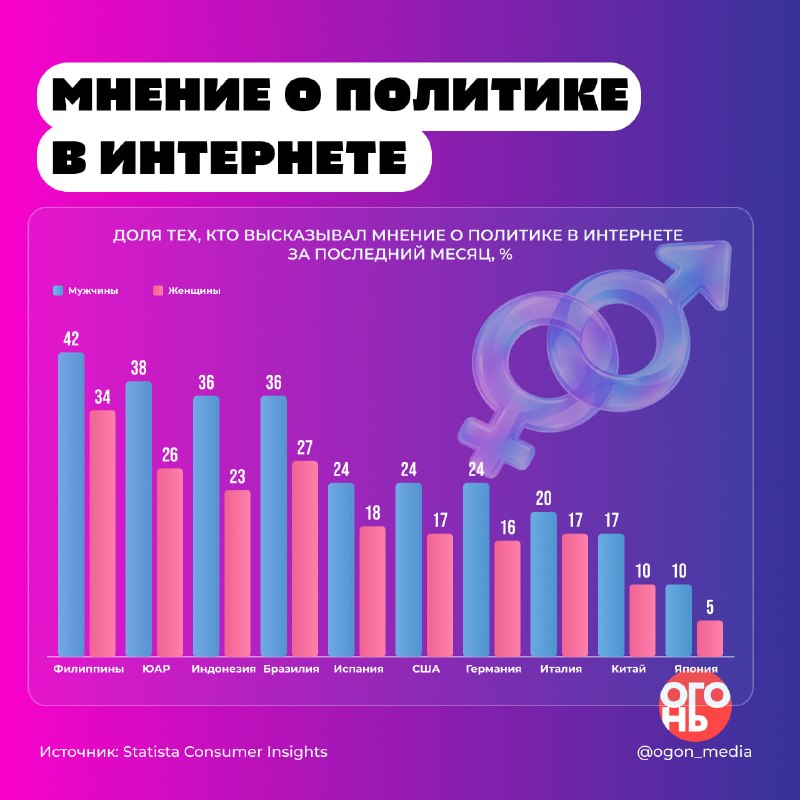
Who sets the political agenda on social media? Women are less likely than men to talk about politics online, and in all 32 countries where the study was conducted. By the way, a like under a political post is also considered a statement, not just a detailed comment. Countries differ only in the size of the gap. The difference is the smallest in Italy: 20% of men and 17% of women talked about politics in a month. A fairly equal picture is also seen in Japan, Canada, Finland and Spain, where the gap is 5–6%. It is highest in Indonesia and Malaysia, 13% each. The most interesting thing is that almost the same amount, 12%, was scored by Sweden, which is considered a model of gender equality. Next to him in this index were South Africa and Austria. It turns out that equality in laws and politics does not in itself make women more active in online conflicts. Countries differ even more in how willing people are to talk about politics online. In Japan only 8% of residents do this, in China 14%. At the other extreme is the Philippines: 38% (42% of men and 34% of women) talked about politics there within a month. They are followed by South Africa, Brazil and Indonesia with 30-32%. However, gender bias does not apply to all subjects. In the United States, for example, men and women are about equally willing to discuss music, movies, and TV shows, but when it comes to politics, a difference immediately appears. Researchers explain this in different ways. Authors of a paper from the University of Mannheim, who analyzed a wide range of notes, associate it with education. From childhood women were taught to avoid political disputes, and for a long time politics was a completely closed field for them. A study from the University of Illinois offers another explanation: men and women use comments differently. Men are more likely to write to correct someone or convey information. Women are more likely to read comments to understand what people think. That is, in fact, women are no less interested in politics, they simply observe more often and are less likely to get involved in disputes.
Who sets the political agenda on social media? Women are less likely than men to talk about politics online, and in all 32 countries where the study was conducted. By the way, a like under a political post is also considered a statement, not just a detailed comment. Countries differ only in the size of the gap. The difference is the smallest in Italy: 20% of men and 17% of women talked about politics in a month. A fairly equal picture is also seen in Japan, Canada, Finland and Spain, where the gap is 5–6%. It is highest in Indonesia and Malaysia, 13% each. The most interesting thing is that almost the same amount, 12%, was scored by Sweden, which is considered a model of gender equality. Next to him in this index were South Africa and Austria. It turns out that equality in laws and politics does not in itself make women more active in online conflicts. Countries differ even more in how willing people are to talk about politics online. In Japan only 8% of residents do this, in China 14%. At the other extreme is the Philippines: 38% (42% of men and 34% of women) talked about politics there within a month. They are followed by South Africa, Brazil and Indonesia with 30-32%. However, gender bias does not apply to all subjects. In the United States, for example, men and women are about equally willing to discuss music, movies, and TV shows, but when it comes to politics, a difference immediately appears. Researchers explain this in different ways. Authors of a paper from the University of Mannheim, who analyzed a wide range of notes, associate it with education. From childhood women were taught to avoid political disputes, and for a long time politics was a completely closed field for them. A study from the University of Illinois offers another explanation: men and women use comments differently. Men are more likely to write to correct someone or convey information. Women are more likely to read comments to understand what people think. That is, in fact, women are no less interested in politics, they simply observe more often and are less likely to get involved in disputes.
🇮🇹 Italy · Map
More on Radar
Want to see every report in real time?
Hundreds of sources worldwide, translated into your language, with alerts for what matters to you.
Sign up free Already have an account? Log in